How to Replace Discontinued ICs: A Complete Guide for EOL Semiconductor Sourcing
Expert strategies for sourcing discontinued IC replacements, managing EOL semiconductor challenges, and securing reliable components for long-term product lifecycle support.
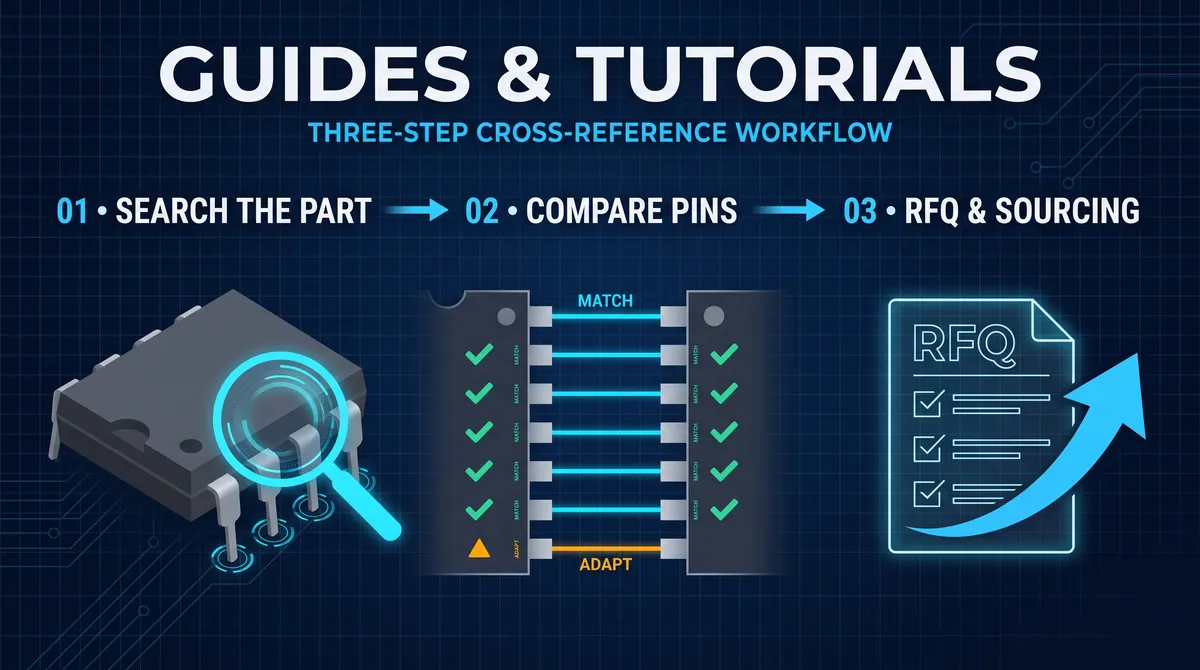
How to Replace Discontinued ICs: A Complete Guide for EOL Semiconductor Sourcing
The semiconductor industry discontinues thousands of integrated circuits (ICs) every year, leaving engineering teams scrambling to secure replacements before existing inventory depletes. This discontinued IC replacement guide addresses one of the most persistent challenges in electronics manufacturing: sourcing viable alternatives when original component manufacturers (OCMs) end-of-life (EOL) their products. According to industry data, over 12,000 semiconductor part numbers reach EOL status annually across major manufacturers, with average time from EOL announcement to last-time-buy (LTB) closure ranging from 90 to 365 days depending on the supplier and component complexity. Engineers and procurement specialists who understand the nuances of EOL semiconductor sourcing can transform this challenge into a strategic advantage, securing reliable component supplies while competitors struggle with supply chain disruptions.
Why Semiconductors Get Discontinued: Understanding the EOL Phenomenon
End-of-life discontinuation in the semiconductor industry occurs when manufacturers decide a particular IC can no longer be economically or technically sustained. The discontinued IC replacement guide must begin by understanding why these decisions happen, as this knowledge directly impacts the available sourcing strategies. Several interconnected factors drive semiconductor EOL announcements, each with distinct implications for component availability and pricing.
Technology advancement cycles continue to compress, with fab processes advancing every 18 to 36 months in leading-edge nodes. As manufacturers transition to smaller process nodes, older fabrication facilities become less economical to operate. A 180nm fab running at 85% capacity may be profitable, but as demand shifts to 28nm and below, the older facility's utilization drops, eventually reaching a point where operating costs exceed revenue. When this threshold occurs, manufacturers consolidate production to newer facilities, discontinuing legacy products that cannot be economically fabricated on advanced nodes.
Market demand shifts also trigger EOL events. When a specific application segment declines—whether due to technology obsolescence, regulatory changes, or shifting consumer preferences—demand for associated ICs falls below economically viable thresholds. The decline of analog television created cascading EOL events across RF tuner ICs, video processing chips, and display driver components over a fifteen-year period. Similarly, the transition from magnetic storage to solid-state drives eliminated demand for legacy HDD controller ICs, forcing manufacturers to discontinue those product lines.
Manufacturing complexity increases as geometries shrink and performance requirements escalate. Some legacy ICs require specialized processes that cannot be replicated on modern fabrication equipment. Analog components with precise voltage references, radiation-hardened ICs with specialized substrate requirements, and high-voltage discrete components often require dedicated manufacturing lines. When these lines require maintenance or upgrade, manufacturers face binary decisions: invest millions in capability retention or discontinue the products entirely.
Cost pressures from global competition accelerate EOL timelines. When Asian semiconductor foundries can produce equivalent functionality at significantly lower costs, Western and Japanese manufacturers struggle to maintain margins on aging product lines. The economic reality forces difficult decisions about portfolio rationalization, with lower-margin products facing discontinuation to focus resources on higher-value differentiated offerings.
Finally, component lifecycle management practices influence EOL timing. Many semiconductor manufacturers follow structured product lifecycle policies, with explicit end-of-sale and end-of-life dates programmed into product roadmaps. Understanding these policies helps procurement teams anticipate discontinuations and plan accordingly, which is why this discontinued IC replacement guide emphasizes proactive lifecycle monitoring.
Recognizing Early Warning Signs of IC Discontinuation
Effective EOL management requires engineers and procurement specialists to recognize discontinuation signals before official announcements arrive. This section of the discontinued IC replacement guide outlines the key indicators that an IC may be approaching end-of-life, enabling proactive response rather than reactive crisis management.
Diminishing distributor inventory represents one of the earliest observable signals. When authorized distributors begin reducing their on-hand stock of a particular IC, this often indicates manufacturer guidance to wind down distribution channels. Inventory reductions may manifest as extended lead times, minimum order quantity (MOQ) increases, or pricing adjustments. Monitoring distributor websites for stock status and lead time changes provides valuable early intelligence about potential EOL events.
Manufacturing date code clustering reveals production pattern shifts that often precede discontinuation. When component date codes suddenly shift to indicate recent production, followed by extended periods with no new production dates, this pattern suggests the manufacturer is running final production lots without committing to ongoing supply. Components with scattered date codes spanning multiple years typically indicate active production, while components showing a clear production endpoint often signal imminent or recent discontinuation.
Product page changes on manufacturer websites frequently telegraph EOL intentions. Removal of detailed specifications, transition from "Active" to "Not Recommended for New Design" (NRND) status, and changes to datasheet headers all indicate lifecycle stage transitions. Some manufacturers explicitly mark products as "Last Time Buy" or display countdown timers for LTB windows. These website changes often precede official EOL announcements by weeks or months, providing valuable preparation time for engineering teams.
Competitive part introductions from the same manufacturer can indirectly signal discontinuation of existing products. When a manufacturer launches a next-generation component with enhanced features or improved specifications targeting the same application space, the legacy product often enters lifecycle wind-down. The new product typically absorbs roadmap attention, engineering support, and manufacturing resources, gradually displacing the older part.
Industry analyst reports and supply chain intelligence services provide another monitoring channel. Organizations like Gartner, IHS Markit, and specialized semiconductor analyst firms track EOL trends across the industry. Subscription to these services or regular review of published reports helps procurement teams anticipate widespread component shortages before they impact production schedules.
Internal demand signals deserve equal attention. When engineering teams request design changes or express concerns about component availability during product development, these observations often reflect real supply chain pressures that will eventually manifest as official EOL announcements. Maintaining communication channels between engineering, procurement, and manufacturing teams ensures early warning information flows to decision-makers.
Strategic Approaches to Finding Discontinued IC Replacements
Finding viable alternatives for discontinued ICs requires systematic methodology rather than ad hoc searching. This section of the discontinued IC replacement guide presents structured approaches for identifying and validating replacement candidates across different sourcing scenarios.
Cross-reference databases form the foundation of systematic replacement search. These databases compile compatibility information from multiple sources: manufacturer cross-reference guides, third-party equivalence tables, distributor matching tools, and community-contributed mappings. Major authorized distributors including Digi-Key, Mouser, Arrow, and Avnet maintain cross-reference functionality on their websites, allowing searches by discontinued part number to return potential alternatives. Specialized cross-reference services like Silicon Expert, IHS Parts, and Octopart aggregate data across multiple distributors and manufacturers, providing comprehensive search capabilities that often reveal replacement options invisible to simple Google searches.
Functional equivalence analysis extends beyond mechanical pin compatibility to evaluate true functional replacement viability. This analysis considers electrical parameters including input voltage ranges, current consumption, switching speeds, and thermal characteristics. An IC may share the same package and pinout but fail functionally if its power supply requirements differ, its output drive strength is insufficient, or its timing characteristics do not meet system requirements. The discontinued IC replacement guide emphasizes thorough functional analysis because superficial compatibility assessments frequently result in field failures that cost far more than the original component shortage.
Second-source identification addresses single-source risk that often accompanies discontinued components. When a specific IC reaches EOL, identifying alternative manufacturers who produce compatible parts reduces future supply chain vulnerability. Some components have established second-source relationships where manufacturers explicitly license production to qualified partners. Other cases require more detective work to identify compatible parts from manufacturers who targeting similar market segments. The goal extends beyond immediate replacement to establishing a more resilient supply base for the long term.
Internal replacement programs within large manufacturers sometimes offer migration paths for discontinued components. Major semiconductor companies maintain product transition programs that map legacy products to newer generations with enhanced capabilities. These programs often include technical documentation, reference designs, and sometimes even replacement component samples to facilitate customer migrations. Engaging directly with manufacturer representatives reveals these programs, which may not be publicly documented but represent officially sanctioned replacement pathways.
Reverse engineering considerations become necessary when no commercial replacement exists. In these situations, engineering teams must evaluate whether custom solutions—either application-specific standard products (ASSPs) or fully custom ASICs—justify the development investment. Custom solutions typically require 6 to 18 months of development time and substantial non-recurring engineering (NRE) costs, making them practical only for high-volume applications or critical systems where no alternative exists.
Types of IC Replacement Strategies: From Drop-In to Redesign
The appropriate replacement strategy depends on multiple factors including time constraints, redesign budget, volume requirements, and regulatory considerations. This section of the discontinued IC replacement guide categorizes the primary replacement strategies and their respective trade-offs.
Drop-in replacement represents the simplest and fastest replacement approach. These components match the original IC in package type, pinout, and electrical specifications, allowing direct substitution without board modifications. Drop-in replacements typically come from three sources: manufacturer-selected second sources established during original product qualification, authorized distributors who have secured last-time-buy inventory, and independent surplus sellers who have acquired end-of-life stock through various channels. The discontinued IC replacement guide notes that drop-in replacements offer the fastest path to production continuity but may carry quality and authenticity risks when sourced outside authorized channels.
Pin-compatible replacements extend the drop-in concept to components with matching footprints but potentially different internal architectures. These replacements may require minor firmware adjustments or initialization sequence changes while maintaining physical compatibility with existing board layouts. Pin-compatible options often appear when manufacturers discontinue products but other vendors offer functionally similar components in industry-standard packages. Careful verification of electrical characteristics and functional behavior remains essential, as the absence of internal compatibility does not guarantee external behavior equivalence.
footprint changes introduce complexity but dramatically expand the available replacement pool. When drop-in and pin-compatible options prove unavailable or unsuitable, components in similar but not identical packages may be adapted through various techniques. Adapter boards allow larger packages to substitute for smaller ones, though these add cost and potential reliability concerns. Pin-adapter solutions provide intermediate complexity, converting pin layouts without the full flexibility of adapter boards. The discontinued IC replacement guide advises that footprint changes should be evaluated carefully against regulatory implications—changes to certified assemblies may require recertification.
Full redesign becomes necessary when no suitable replacement exists in any compatible form factor. Redesign approaches vary based on scope: minimal redesigns replace only the discontinued IC while preserving surrounding circuit topology, moderate redesigns may adjust nearby components to accommodate different replacement ICs, and comprehensive redesigns treat the system more holistically, potentially incorporating technology advances that were unavailable when the original design was created. Redesign timelines range from weeks for minimal changes to months or years for comprehensive overhauls, with corresponding cost implications.
Buffer stock acquisition represents a procurement strategy rather than a technical replacement approach, but it often serves as an interim solution while longer-term replacement strategies mature. Purchasing sufficient inventory to cover anticipated lifetime requirements eliminates immediate supply concerns but introduces inventory carrying costs, potential quality degradation during extended storage, and technology obsolescence risk if the overall product line itself becomes discontinued. This strategy works best for components with long product lifecycles and stable demand patterns.
Multiple-sourcing qualification establishes alternative suppliers for critical components before discontinuation occurs. Proactive qualification of second sources, even when not immediately needed, creates insurance against future EOL events. This approach requires engineering investment during normal operations but dramatically reduces crisis response requirements when discontinuations inevitably occur. The discontinued IC replacement guide strongly recommends this approach for high-volume production lines and critical system applications.
Working with Authorized Distributors for EOL Components
Authorized distributors serve as the primary legitimate channel for sourcing discontinued ICs, offering traceability, authenticity guarantees, and manufacturer support that independent brokers cannot match. This section of the discontinued IC replacement guide details effective strategies for engaging with authorized channels during EOL scenarios.
Last-time-buy facilitation represents the core authorized distributor service during EOL events. When manufacturers announce discontinuation, authorized distributors typically receive allocation to purchase final production quantities before fab closure. These quantities become available to customers through LTB programs, often with extended lead times and minimum quantity requirements but guaranteed authenticity and manufacturer support. Distributors may also accept LTB orders on behalf of customers, aggregating demand to meet manufacturer MOQs that individual customers cannot satisfy independently.
Excess inventory programs provide mechanisms for redistributing surplus stock that other customers no longer require. When organizations face product line discontinuations of their own, excess component inventories become available through distributor exchange programs. These programs allow selling organizations to recover value from surplus stock while providing buying organizations access to legitimate components at below-new pricing. The discontinued IC replacement guide notes that inventory freshness requires verification, as components may have been in distributor warehouses for extended periods.
Authorized distributor cross-ship programs enable rapid component delivery during shortage situations. When a customer faces production-critical component shortages, distributors can arrange cross-shipment from other customer locations or regional warehouses, often with expedited logistics at premium pricing. These programs work best for urgent situations where production line downtime costs exceed premium logistics expenses.
Direct manufacturer engagement through distributor relationships often provides access to transition support unavailable through other channels. Manufacturer application engineering teams may assist with replacement selection, design review, and qualification testing for customers working through official transition programs. Distributors facilitate these engagements, acting as intermediaries who can coordinate manufacturer resources on behalf of customers.
Distributor inventory monitoring tools help procurement teams track availability of critical components across distribution networks. Real-time inventory visibility systems show stock levels at multiple warehouse locations, enabling procurement optimization across geography and logistics cost. These tools prove particularly valuable during shortage periods when components may be available at distant warehouses but not locally.
Quality assurance and warranty coverage through authorized channels exceeds what independent brokers can provide. When sourcing components that will be used in safety-critical or high-reliability applications, the authenticity guarantees and traceability documentation that authorized distributors provide become essential. The discontinued IC replacement guide emphasizes that cost savings from independent sources often prove false economy when warranty claims, field failures, and liability exposure are properly accounted.
Alternative Sourcing Channels for Hard-to-Find ICs
When authorized channels cannot satisfy component requirements, alternative sourcing channels provide additional options with corresponding trade-offs. This section of the discontinued IC replacement guide evaluates these channels with appropriate risk considerations.
Independent distributors operate outside manufacturer authorization but often hold substantial component inventories accumulated through various channels. These organizations serve critical functions in the semiconductor supply chain, providing availability for hard-to-find components while accepting elevated risk regarding authenticity and quality. Working with established independent distributors with strong industry reputations and verification capabilities reduces but does not eliminate these risks. The discontinued IC replacement guide recommends thorough due diligence before establishing relationships with independent sources.
Broker networks connect component buyers with sellers through marketplace platforms rather than maintaining physical inventory. These networks aggregate supply and demand, matching requirements with available stock across thousands of independent sellers. Platform-based verification, escrow payment protection, and seller rating systems provide some risk mitigation, though buyers must remain vigilant against sophisticated counterfeiting operations that sometimes infiltrate even reputable platforms.
OEM and EMS surplus programs provide another avenue for component acquisition. Contract manufacturers and original equipment manufacturers occasionally hold inventory of components no longer required due to product line changes, design revisions, or demand fluctuations. These organizations may sell surplus stock through direct negotiation, auction platforms, or specialized surplus buyers. Components from these sources often carry strong authenticity credentials since they originated from authorized supply chains, though storage conditions and inventory age require verification.
Surplus and salvage operations recover components from decommissioned electronic equipment, representing the most risky sourcing category. These components, sometimes called "pulled" or "harvested" parts, have been removed from end-of-life assemblies and may exhibit degraded performance, latent damage, or uncertain provenance. While occasionally useful for hobbyist or educational applications, the discontinued IC replacement guide strongly advises against using salvaged components in production equipment where reliability is paramount.
Gray market channels exist in the space between fully authorized and completely illegitimate sourcing. Components that have been legitimately manufactured but diverted from authorized distribution channels may appear in these markets. While technically authentic, these components may have been stored improperly, may lack traceability documentation, and typically void manufacturer warranties. Risk levels vary substantially depending on specific channel characteristics and seller reputations.
Geographic arbitrage opportunities occasionally arise from price differentials across regional markets. Components may be legitimately available in some geographic regions at lower prices than others, creating arbitrage opportunities for organizations with international procurement capabilities. These opportunities require careful attention to import/export regulations, counterfeit prevention requirements, and logistics complexity that often eliminate the apparent price advantage.
Technical Considerations for IC Replacement Selection
Successful IC replacement requires careful evaluation of technical compatibility beyond simple specification matching. This section of the discontinued IC replacement guide addresses the critical technical factors that determine whether a replacement will function properly in its intended application.
Electrical parameter comparison must encompass all relevant specifications, not merely headline characteristics. While input voltage range and current consumption often receive primary attention, subtle differences in ESD protection levels, input leakage currents, and power-on reset behavior can cause system-level failures that are difficult to diagnose. The discontinued IC replacement guide recommends comprehensive parameter comparison using datasheet analysis tools and, where possible, side-by-side testing on evaluation platforms.
Pinout compatibility verification ensures physical connection compatibility between the replacement IC and existing board infrastructure. Package type, pin count, pin spacing, and lead finish all affect whether a component can be physically mounted without modification. Beyond mechanical compatibility, pin function mapping must be verified—even when pin counts match, functional assignments may differ between components. Careful pin-by-pin comparison against original and replacement datasheets reveals potential mismatches.
Timing and signaling compatibility determines whether replacement ICs can communicate properly with surrounding components. Bus interface timing parameters including setup times, hold times, and propagation delays must fall within specification ranges for reliable operation. Clock distribution characteristics, reset timing sequences, and interrupt handling all require verification. The discontinued IC replacement guide notes that timing compatibility is particularly critical in high-speed interfaces where small differences accumulate to cause communication failures.
Thermal performance evaluation addresses how replacement ICs behave across the expected operating temperature range. Thermal resistance differences affect junction temperatures at given power dissipation levels. Thermal shutdown behavior and temperature derating characteristics may differ between manufacturers. Components specified for commercial temperature ranges may not meet automotive or industrial requirements even if room-temperature specifications appear equivalent.
Software and firmware compatibility becomes critical for programmable ICs including microcontrollers, memory devices with serial IDs, and configurable logic. Register maps, command sequences, initialization requirements, and feature availability must be verified against existing software implementations. A drop-in replacement that requires software modifications effectively becomes a pin-compatible replacement with corresponding qualification complexity.
Electromagnetic compatibility considerations affect system-level certification compliance. Replacement ICs with different internal architectures may exhibit different EMI signatures, potentially causing radiated or conducted emissions to exceed limits that the original component satisfied. The discontinued IC replacement guide recommends EMC testing whenever replacement components are introduced into certified assemblies.
Manufacturing compatibility ensures that replacement components can be reliably assembled using existing production processes. Solderability characteristics, moisture sensitivity levels, and reflow profile requirements must align with established manufacturing capabilities. Components with different moisture sensitivity ratings may require additional handling precautions or baking processes that introduce production complexity.
Cross-Reference Databases and Tools for Replacement Search
Systematic replacement search requires access to comprehensive databases and analytical tools. This section of the discontinued IC replacement guide reviews the primary resources available for component replacement research.
Manufacturer cross-reference resources represent the most authoritative replacement guidance available. Major semiconductor manufacturers publish cross-reference guides that map discontinued products to recommended replacements, often including detailed migration documentation. These cross-references carry manufacturer warranty and support, making them preferred starting points for replacement search. However, manufacturer cross-references may be limited to products within their own portfolios, potentially missing viable replacements from competitors.
Distributor cross-reference tools aggregate manufacturer data with proprietary matching algorithms to suggest alternatives across multiple suppliers. Digi-Key's cross-reference function, Mouser's parametric search, and Arrow's Quoter tools provide immediate access to potentially compatible alternatives when searching for discontinued part numbers. The discontinued IC replacement guide values these tools for speed and breadth but recommends verification against authoritative sources before committing to any specific replacement.
Third-party parametric databases like Silicon Expert, IHS Parts (now part of Research and Markets), and Component Search Engine provide comprehensive search capabilities that span multiple manufacturers and distributors. These services aggregate datasheet information, lifecycle status, and cross-reference data into searchable databases with varying coverage depths. Enterprise subscriptions provide advanced features including lifecycle risk scoring, multi-tierBom analysis, and supply chain risk assessment that extend beyond simple replacement search.
Octopart and similar aggregation platforms pull data from hundreds of distributors, providing real-time availability and pricing information alongside parametric data. While primarily focused on availability rather than compatibility, Octopart's comparison features help identify alternative components that multiple distributors stock, potentially indicating broader market acceptance and easier long-term sourcing.
Community resources including electronics forums, component database wikis, and open-source BOM tools provide supplementary replacement information contributed by practicing engineers. These resources often reveal practical replacement experience that official documentation does not capture. The discontinued IC replacement guide suggests treating community information as input to further research rather than authoritative guidance, as contributor expertise levels and application contexts vary widely.
Custom database development becomes worthwhile for organizations with large component libraries and frequent EOL challenges. Building internal databases that capture historical replacement experiences, approved alternative lists, and component equivalency determinations creates institutional knowledge that improves over time. Integration with enterprise resource planning systems enables automated replacement suggestion when engineers enter discontinued part numbers into bill-of-materials systems.
Building a Proactive EOL Management Strategy
Reactive response to EOL announcements creates unnecessary cost and risk. This section of the discontinued IC replacement guide presents a comprehensive framework for proactive EOL management that transforms semiconductor lifecycle challenges from crises into manageable processes.
Lifecycle monitoring programs establish systematic surveillance of component availability across product portfolios. These programs track EOL announcements, distributor inventory levels, and market pricing trends for critical components. Automated alerts notify procurement and engineering teams when components of interest approach EOL status, enabling response planning before last-time-buy windows close. The discontinued IC replacement guide emphasizes that monitoring programs require ongoing maintenance as component portfolios evolve and monitoring scope must expand to cover new products.
Design for second-source practices incorporate alternate component selection into standard engineering workflows. When initially selecting components, engineers should evaluate second-source availability and, where practical, design boards to accommodate multiple pin-compatible alternatives. These practices add modest upfront effort but dramatically reduce redesign requirements when primary components reach EOL. The discontinued IC replacement guide recommends creating second-source preferred parts lists that engineering teams can reference during component selection.
Buffer inventory strategies establish appropriate safety stock levels for components with elevated discontinuation risk. Risk-based inventory modeling considers historical EOL frequency, component criticality, supplier concentration, and demand predictability to determine appropriate buffer quantities. Organizations with strong demand forecasting capabilities can optimize buffer levels more aggressively, while those with uncertain demand may require larger safety stocks. The discontinued IC replacement guide notes that buffer strategies involve trade-offs between inventory carrying costs and shortage costs that must be evaluated against organizational risk tolerance.
Long-term agreement structures with distributors and manufacturers provide supply assurance for critical components. Volume commitment agreements, price-lock arrangements, and allocation priority provisions can be negotiated for components approaching EOL or for strategic parts that the organization considers essential. These agreements require careful legal review but can provide supply certainty that volatile spot markets cannot match.
Component qualification acceleration programs prepare replacement components for rapid deployment when primary components discontinue. By qualifying alternate components during normal operations—rather than waiting for crises—organizations maintain ready alternatives that can be deployed immediately upon EOL announcement. The discontinued IC replacement guide notes that qualification acceleration requires ongoing investment but pays dividends during every EOL event.
Cross-functional EOL response teams ensure that organizations respond to discontinuations with appropriate expertise. These teams typically include representatives from engineering, procurement, quality, and manufacturing who collaborate on replacement selection, qualification, and production implementation. Clear escalation pathways and decision authorities prevent response delays while ensuring appropriate stakeholder input into consequential decisions.
Common Pitfalls in Discontinued IC Replacement
Even experienced procurement teams encounter predictable challenges when managing EOL situations. This section of the discontinued IC replacement guide addresses common pitfalls and strategies for avoiding them.
Underestimating qualification complexity frequently leads to production delays. When replacement components appear superficially compatible, teams may assume qualification will be straightforward. However, subtle differences in timing, initialization, or thermal behavior often require more extensive testing than initially anticipated. Building realistic qualification timelines that include contingency for unexpected findings prevents schedule surprises.
Excessive parts consolidation during shortage periods creates future vulnerability. When component shortages make it difficult to secure second sources, organizations sometimes consolidate around single-source solutions to reduce procurement complexity. While this approach solves immediate shortages, it concentrates risk in ways that create severe vulnerability when those sole-source components eventually discontinue. The discontinued IC replacement guide advises maintaining second-source capability even when it involves some additional cost and complexity.
Ignoring counterfeit risk in urgent shortage situations leads to quality and liability exposure. When production schedules are at risk, procurement teams may relax supplier qualification requirements to secure any available inventory. Counterfeit components that enter production systems create warranty exposure, field failure risk, and potential liability that far exceeds any short-term procurement savings. The discontinued IC replacement guide emphasizes that supplier qualification standards must remain firm even under pressure.
Failing to communicate EOL status across the organization allows problems to compound. When engineering teams discover component availability issues but fail to inform procurement or manufacturing, the organization loses valuable response time. Establishing clear communication protocols ensures that EOL information flows to all stakeholders who need to participate in response activities.
Allowing last-time-buy windows to expire without action represents a preventable failure mode. The pressures of daily operations sometimes push EOL response activities off priority lists until LTB deadlines pass. Automated LTB tracking with escalation alerts helps ensure that response activities receive appropriate attention before windows close. The discontinued IC replacement guide recommends treating LTB deadlines as hard constraints that cannot be extended through effort alone.
Overlooking long-term cost implications of replacement decisions creates future financial pressure. The lowest-cost replacement may carry higher unit pricing than alternatives, may require more expensive assembly processes, or may have higher field failure rates that increase warranty costs. Total cost of ownership analysis that considers all lifecycle costs provides more appropriate basis for replacement selection than unit price alone.
Case Studies: Successful EOL Transitions
Practical examples illuminate how organizations successfully navigate IC discontinuations. This section of the discontinued IC replacement guide presents anonymized case studies that illustrate key principles in action.
Case Study 1: Automotive Sensor Module Transition involves a Tier 1 automotive supplier facing discontinuation of a magnetic sensor IC used in wheel speed sensing applications. The original component had been qualified to AEC-Q100 Grade 0 specifications for automotive temperature ranges, with ISO 26262 functional safety documentation that supported ASIL B system-level compliance. Replacement candidates from three manufacturers offered various combinations of functional compatibility, qualification status, and availability.
The organization established a cross-functional team including sensor engineering, functional safety, quality, and procurement representatives. Initial assessment identified two pin-compatible alternatives that met electrical specifications. However, detailed analysis revealed that only one alternative had been characterized to AEC-Q100 Grade 0 temperature ranges, while the other was limited to Grade 1. Further evaluation showed that only one manufacturer had published the documentation required to support ISO 26262 reuse arguments.
The selected replacement required minor firmware modifications to accommodate different register initialization sequences but achieved full compatibility with existing software infrastructure. Total qualification timeline extended across six months, including hardware characterization, software validation, and system-level testing. The investment in thorough qualification paid dividends during subsequent production, with zero field failures attributable to the replacement component across a three-year production period.
Case Study 2: Industrial Control System Redesign addresses a programmable logic controller manufacturer dealing with discontinuation of multiple DSP and microcontroller components used in motor control applications. Unlike the automotive case, no pin-compatible alternatives existed, and the product's extended lifecycle (15+ years remaining) justified comprehensive redesign investment.
The engineering team evaluated multiple replacement strategies ranging from minimal change to complete redesign. Analysis revealed that minimal-change approaches would require components from multiple manufacturers with different development tools and documentation, increasing long-term maintenance complexity. Complete redesign using a modern microcontroller family offered integration benefits and simplified supply chain but required extensive software development.
The selected approach involved moderate redesign: replacing three discontinued components with two modern devices that offered equivalent functionality with enhanced performance. This approach balanced development effort against long-term simplification, ultimately reducing component count by 33% while improving processing capability by 50%. The discontinued IC replacement guide notes that this type of comprehensive approach works best when organizations have sufficient runway to execute development without production interruption.
Case Study 3: Consumer Electronics Quick Response demonstrates rapid response to unexpected discontinuation in a consumer electronics product with seasonal demand patterns. The original EOL announcement came with only 60-day LTB window, inadequate time for traditional qualification approaches.
The procurement team immediately secured maximum available LTB inventory while engineering teams evaluated alternative components. Distributor cross-reference tools identified a pin-compatible replacement from an alternate manufacturer that had recently entered the market. The replacement had limited production history but showed strong parametric alignment with the original component.
The organization implemented a parallel production approach, qualifying the replacement component on accelerated timelines while manufacturing continued with original inventory. By the time original inventory depleted, the replacement had completed shortened qualification including functional testing and limited field evaluation. The rapid response preserved production continuity while accepting slightly elevated qualification risk.
Future Trends in EOL Semiconductor Management
The semiconductor industry's structural dynamics continue evolving, with implications for EOL management practices. This section of the discontinued IC replacement guide examines emerging trends that will shape how organizations manage component lifecycle challenges going forward.
Manufacturing consolidation accelerates as foundries merge and older facilities close. The number of companies capable of manufacturing mature-node semiconductors continues declining, concentrating production risk for legacy components. Organizations relying on mature-node ICs should anticipate increased EOL frequency and shorter LTB windows as manufacturers seek to exit unprofitable product lines.
Design automation advances reduce redesign effort required when component replacements demand circuit modifications. Electronic design automation tools increasingly support automatic translation of designs between compatible components, potentially reducing qualification timelines. However, the discontinued IC replacement guide notes that automation cannot replace human judgment in evaluating whether automatic translations preserve intended functionality.
Circular economy practices create new channels for component recovery and reuse. Environmental regulations and corporate sustainability commitments drive increased attention to electronics recycling and component recovery. While recovered components face suitability limitations for new production, they may serve valuable functions in repair and maintenance applications. Organizations may increasingly need to consider both forward and reverse logistics when developing EOL response strategies.
Artificial intelligence applications in component search and replacement identification promise more comprehensive analysis than traditional databases. Machine learning models trained on component datasheets, application notes, and qualification records may identify replacement candidates that human analysts miss. Early implementations show promise for reducing search time and improving match quality, though the discontinued IC replacement guide advises careful validation of AI-generated recommendations against authoritative sources.
Regulatory requirements for component traceability continue tightening, particularly in automotive, medical, and aerospace sectors. These requirements influence acceptable sourcing channels for replacement components, potentially limiting options to fully authorized supply chains even when independent sources offer lower pricing. Organizations must balance cost considerations against compliance requirements when selecting replacement sourcing strategies.
Conclusion
Managing discontinued ICs effectively requires systematic processes, technical expertise, and strategic planning that extend far beyond simple component procurement. This discontinued IC replacement guide has presented comprehensive coverage of EOL semiconductor sourcing from recognition of warning signs through implementation of replacement solutions. Organizations that invest in proactive lifecycle monitoring, systematic replacement qualification, and cross-functional response capabilities transform EOL challenges from crises into manageable processes.
The semiconductor industry's structural dynamics ensure that EOL events will continue occurring at current or increasing rates. Manufacturing consolidation, technology advancement, and cost pressures show no signs of abating. Organizations that build EOL management capabilities today will maintain competitive advantages in production continuity, cost control, and supply chain resilience tomorrow.
Key takeaways from this discontinued IC replacement guide include the importance of early warning systems that detect EOL indicators before official announcements, systematic evaluation approaches that ensure replacement candidates meet all relevant technical requirements, and proactive strategies that prepare replacement options in advance rather than scrambling during crisis conditions. The specific tactics, tools, and channels described throughout this guide provide actionable guidance that engineering and procurement teams can implement immediately.
Successful EOL management ultimately reflects broader organizational capabilities in supply chain management, technical problem-solving, and strategic planning. By treating EOL events as opportunities to strengthen supply chain resilience rather than merely threats to production continuity, organizations can turn semiconductor lifecycle challenges into competitive differentiators that support long-term business success.
Not sure which sensor fits your project?
Talk to our mmWave application engineers for a free consultation.
Specify your hotel project with our engineers
Send your room count, ceiling type, and protocol preference. We will return a sample plan and quote within 24 business hours.
- Move from general guidance into a product or application discussion.
- Use RFQ when pricing, drawings, MOQ, or launch timing needs structure.
- Keep a direct contact path visible for fast clarifications and handoff.