Obsolete Electronic Components: An Engineers FAQ
Obsolete electronic components FAQ for engineers: what obsolete and EOL mean, how to find replacements, source originals, and plan for end-of-life parts.
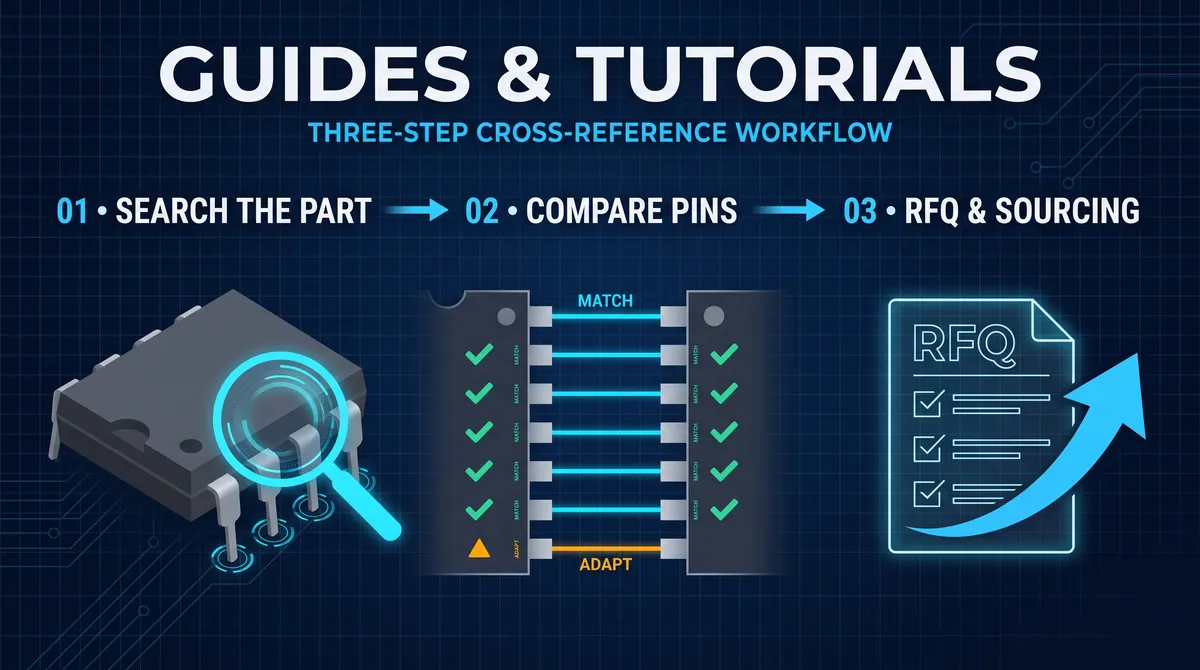
Obsolete electronic components replacement is a subject that every engineer and every buyer eventually has to face, and the questions around it are remarkably consistent because the market behaves the same way every time a part goes end-of-life. An obsolete electronic component is a part that the original manufacturer no longer produces, and the moment that happens the buyer loses the normal channel and enters a thinner market of independent distributors, brokers, and legacy stock, while the product built around the part keeps needing it. The questions that follow are the ones this FAQ answers: what obsolete and end-of-life actually mean, whether an obsolete part can still be bought, how to find a replacement or qualify one, how to verify that a legacy part is authentic, and how to plan so the next end-of-life event is not an emergency. The answers are the same discipline this site's guides have laid out, and this FAQ collects them in the question-and-answer form that engineers search for.
The FAQ also reads the questions that the search data shows real engineers asking, because the SERP for obsolete electronic components replacement surfaces the same inquiries in every market. What does obsolete mean, what is EOL in electronics, where can I buy obsolete parts, is a replacement as good as the original, are we back in a shortage, and the rest, and the answers here are written for the engineer who is mid-design or mid-procurement and needs the straight answer rather than the marketing page. The FAQ is deliberately practical, each question answered with the definition, the distinction, and the action, and it closes with the planning frame that turns obsolescence from a crisis into a schedule. A reader who finishes the FAQ has the vocabulary, the method, and the plan, which is the entire value of the subject.
What Does Obsolete Electronic Components Mean
Obsolete electronic components are parts that the original manufacturer has stopped producing, and the term describes a supply state rather than an age. A part becomes obsolete when the manufacturer discontinues it, whether because a newer product replaced it, because the process it was built on is no longer economical, or because the market for its function moved on, and after the discontinuance the manufacturer no longer fabricates it. The consequence is structural: the total remaining supply of the part is whatever inventory exists in the world, the residual stock in the distributors, the last-time-buy surplus that buyers ordered before the cutoff, and the legacy inventory that the specialists hold, and every unit of that finite pool is a unit that will not be replaced. An obsolete part is therefore a part whose supply is finite and falling, and the buyer's job is to map that pool and to secure the volume the product needs before it draws down. The term obsolete is the industry-standard word for the state, and it is the word the sourcing market organizes itself around.
The word obsolete also carries a precise family of related terms that the sourcing practice uses, and separating them keeps the notices readable. End-of-life, or EOL, is the formal stage that the manufacturer declares, with the notice that states the last order date and the last shipment date. Discontinued is the everyday word for the same state, more common in the American catalogs and equivalent to obsolete in meaning. Last-time-buy, or LTB, is the final order window that the EOL notice opens. Not recommended for new design, or NRND, is the lifecycle status that tells designers not to use a part in anything new even before it stops. A buyer who reads the vocabulary reads the lifecycle, and the reading is the first step of the replacement method, because the plan starts at the first signal rather than at the final cutoff.
The difference between obsolete and end-of-life
Obsolete and end-of-life describe the same end state from two angles, and the difference is the view rather than the fact. End-of-life is the lifecycle stage, the formal position of a part in the manufacturer's catalog when it is being retired, marked by the notice and the dates, and it is the frame the manufacturer publishes. Obsolete is the market state, the part's position in the buying world after the manufacturer has stopped producing it, and it is the frame the buyer faces. A part is declared end-of-life by the manufacturer and becomes obsolete in the market, and the two words describe the same fact from the two sides of the notice. The sourcing response is the same for both, watch the lifecycle, read the notice, buy the last-time-buy, qualify the replacement, and source the remaining pool, and the terminology is the map rather than the message.
Can You Still Buy Obsolete Electronic Components
Yes, obsolete electronic components can still be bought, through the market that exists specifically to supply the parts the mainstream channel has abandoned. The first source is the authorized distributor, which holds the residual stock of a recently discontinued part bought before the cutoff, and which sells it with the manufacturer's documentation, but which clears quickly and cannot replenish. The second source is the independent distributor that specializes in obsolete and hard-to-find components, which holds legacy inventory acquired over decades, buys last-time-buy surplus, stores it under controlled conditions, and tests what it ships, and which is the backbone of the long-term supply. The third source is the broker, which can find almost any part across the gray market, but which carries the least provenance and demands the fullest verification from the buyer. The answer to the question is yes, with the discipline of the source: the independent specialists hold the stock, and the buyer qualifies the source, verifies the lot, and keeps the evidence.
The availability of an obsolete part depends on its place on the market's ladder, and reading the ladder sets the expectation. A part discontinued in the last year is still findable at reasonable prices through the authorized channel and the well-stocked independents, because the surplus is still being worked. A part discontinued five years ago lives at the independents who bought the stock and stored it, and its price reflects the scarcity and the years of storage. A part discontinued twenty years ago exists only in the deep legacy inventories and the broker channel, and its price can be many times the original because the pool is nearly gone. The buyer who reads the ladder knows where to look and what the price should be, and the buyer who plans the purchase early finds the part at the reasonable point on the ladder, which is the practical answer to buying obsolete parts.
Where to buy obsolete electronic parts
The places to buy obsolete electronic parts are the same short list across the industry, and the buyer's qualification of them is the difference between a plan and a gamble. The authorized distributors serve the fresh discontinuance with the manufacturer's documentation, and they are qualified by the relationship. The independent specialists serve the legacy tail, the lifetime-buy surplus and the bought inventories, with their test capability and their references, and they are qualified by the history, the facilities, and the documents. The brokers serve the fragmented units, and they are qualified only by the verification the buyer runs on the lot. The marketplaces and the auction platforms aggregate the sellers and shift the verification onto the buyer, and they are used with the full inspection. The professional buyer keeps a short list of the qualified independents for the long-term supply, uses the authorized channel for the fresh parts, and treats the brokers and the marketplaces with the full verification ladder, which is the method that makes the obsolete market usable.
How Do I Find a Replacement for an Obsolete IC
Finding a replacement for an obsolete IC runs through the same search that every substitution uses, with the archive of the original datasheet as the first stop. Capture the part's identity first, the exact number, the package, the function, and the key parameters, and pull the archived datasheet when the manufacturer has removed the current one, because the pinout and the specification are the standard every candidate is measured against. Search the number and the family in the cross-reference, a distributor's alternative-part feature, an aggregation platform, or a dedicated cross-reference engine, and collect the candidates from more than one source because each database has gaps. Then qualify the candidates with the three-layer review that this series has used, the package and the pinout, the electrical specification across the operating range, and the behavior test including the firmware check for the digital parts, and the surviving candidate is the replacement. The search finds the candidates and the review chooses the replacement, which is the division of labor that the whole method rests on.
The replacement decision then runs the standard three options, because a found candidate is one path and not the only one. The source option finds the original through the remaining channel, the independent specialists and the brokers, and it is the answer when the part must stay the original for the certification or the installed base. The substitute option finds the pin-compatible or the equivalent replacement, verified to the board and the circuit, and it is the answer when the board can be preserved and the software can adapt. The redesign option builds the board around a current part, and it is the answer when no source and no substitute can carry the horizon. The decision is made on the evidence, the remaining product life, the part's availability, and the cost of each path, and it is recorded with the comparison, so the search that finds a candidate and the search that finds none both end in a plan.
How to cross-reference an obsolete part number
Cross-referencing an obsolete part number is a search with the family as the lever. Enter the exact number first, and read the candidates the databases map to it. Search the base family second, dropping the prefix and the suffix, because the family name reaches the vendor variants that the exact-number search misses, and an obsolete part that was second-sourced under different prefixes has its equivalents under the family name. Search the function and the package third, when the number is obscure, and let the parametric filter constrain the candidates by the footprint and the key parameters. Cross-check in a second tool, because the union of two databases covers the gaps of either, and read the datasheets of the shortlist, because the catalog says possible and the datasheet says fit. The cross-reference is the fast path and the datasheet is the safe path, and the two together find the obsolete part's replacement.
Is a Replacement as Good as the Original
A qualified replacement can be as good as the original in the application, and the word qualified is the entire answer, because a replacement earns the comparison on the verification rather than on the claim. The replacement that passes the three-layer review, the package, the pins, and the electrical behavior across the operating range, and the bench test against the original's recorded measurements, matches the original's performance in the design, and for the parts in the well-mapped families, the 78xx regulators, the logic parts, and the timers, the match is routine. The replacement that fails the review does not match, and the difference shows in the output that sags, the timing that shifts, the software that needs the port, or the temperature that drifts, which is exactly why the verification exists. The honest answer is that a verified replacement matches the original in the design it was tested for, and an unverified one matches only the listing, which is the difference the whole method protects against.
The comparison also carries the dimension the original had and the replacement must match, because the parts with special behavior need the special check. A part with a certification, a safety grade, or a proprietary function is matched only by a replacement with the same certification or the same function, and the replacement in the commodity families does not carry that weight. A microcontroller replacement matches the original only when the firmware ports and the peripherals behave, and the replacement in the analog path matches only when the precision and the noise hold. The "as good as the original" question is therefore a per-application answer, and the method that answers it is the verification, the datasheet, the bench, and the record, which is the same method this site applies to every part it sources and replaces.
How Do I Verify an Obsolete Part Is Authentic
Verifying an obsolete part is authentic runs the same ladder that protects every critical buy, scaled to the higher risk of the legacy market. Run the visual inspection first, the markings, the package, the leads, and the body, under magnification, and compare against the authentic sample and the archived datasheet, because the recycled, remarked, and blacktopped parts that dominate the counterfeit supply of obsolete components are caught at the cheapest rung. Run the electrical verification next, the functional and the parametric test against the archived datasheet, and the curve comparison where the part lends itself, because the part whose repeated resale has degraded its behavior shows up on the bench. Run the physical inspection on the risky lots, the X-ray and the decapsulation, because the internal die and the wire pattern settle the identity of the scarce and the valuable parts. The verification scales with the risk, a commodity legacy chip gets the visual and the sampling, and a scarce or safety-critical part gets the full ladder, which is the rule that keeps the cost proportionate.
The verification also covers the usability that legacy stock specifically needs, because an authentic part that cannot be used is as bad as a fake. Check the solderability of the leads after the years of storage, the moisture sensitivity of the package, and the shelf-life marks, because an authentic part whose leads will not reflow cleanly, or whose package absorbed the moisture, fails the line even though it is genuine. Run the sample through a test reflow and the product's own test, and keep the record, the photographs, the test data, and the X-ray images, with the lot. The verification is the buyer's defense in a market where the parts have passed through many hands, and the record is the evidence that protects the line and the audit, which is the discipline that makes the legacy market usable.
What documents prove an obsolete part is authentic
The documents that prove an obsolete part is authentic are the same documents the sourcing series reads, and they are concrete. The certificate of conformance names the part, the lot, the quantity, the manufacturer, the date code, and the tests, and it is the supplier's claim, worth reading against the lot in hand. The test report shows the actual inspection, the visual photographs, the electrical data, and the X-ray results, and it is the evidence behind the certificate. The lot traceability ties the part back to the manufacturer, the date code, and the purchasing channel, and it shows how many hands the part passed through. The archived datasheet supplies the original document when the manufacturer has removed it, and it is the standard the part must meet. A supplier that produces these documents routinely is a source, and a supplier that produces a one-line certificate is a risk, and the buyer reads the document against the part rather than accepting the claim, which is the verification's final check.
What Should I Do If My Part Is Discontinued
The response to a discontinued part is a sequence that any buyer runs in the same order, and it turns the notice from a surprise into a plan. First, read the notice, the end-of-life dates, the last order date, the last shipment date, and the recommended replacement, and capture the demand the product still has, the forecast, the installed-base spares, and the service stock. Second, decide the response, source the original through the remaining channel, substitute a pin-compatible or equivalent replacement, or redesign around a current part, on the evidence of the remaining life, the part's availability, and the board's complexity. Third, buy, place the last-time-buy at the normal price for the volume the horizon needs, with a safety buffer, and record the calculation. Fourth, source, qualify the supplier, verify the lot, and buy the volume the pool requires. Fifth, qualify the replacement in parallel, so the line never depends on a single outcome. And sixth, record everything in the BOM's change log, so the next reviewer sees the plan. The sequence is the operating answer to the discontinued part, and it is the same sequence the sourcing guides have laid out.
The sequence also reads the compliance dimension, because a certified part changes the response. A part under an agency approval, a safety classification, or a medical or aerospace qualification is matched only by a replacement with the same certification, and the certification work starts early rather than at the pilot. The compliance record travels with the change, the certificates, the approvals, and the RoHS and REACH status, so the product keeps its approvals through the transition. The response to a discontinued part is therefore a plan with an evidence trail, and the trail is what makes the plan defensible, which is the professional outcome the whole series exists to create.
Are We in an Electronics Component Shortage in 2026
The shortage question appears in the search data and in every market's conversations, and the honest answer is that the electronics supply chain runs in cycles, with the tightness, the allocation, and the price pressure alternating with the surplus. The shortage events of the recent years taught the industry the value of the tools this series describes, the second source, the buffer stock, the lifecycle watch, and the qualified independent channel, and a buyer who keeps those tools current is prepared for the tight phases regardless of the cycle. The obsolete and the scarce parts feel the tightness first, because the finite pool shrinks and the buyers compete for the remaining units, which is why the obsolete part's price and availability are the early signal. The professional answer to the cycle is the planning discipline, source the critical parts with a buffer, qualify the alternatives while the market is calm, and watch the lifecycle so the end-of-life notices arrive with the runway. The cycle will keep cycling, and the discipline is the constant, which is the practical reading of the shortage question.
How Do I Find the Datasheet of an Obsolete Part
Finding the datasheet of an obsolete part is the first task of any replacement work, because the original document is the standard every candidate is measured against, and the manufacturer often removes it when the part retires. The first place to look is the archive, the datasheet-aggregator sites that store the manufacturer's original documents even after they disappear from the vendor's site, and these archives are the reliable source for the exact pinout, the absolute maximum ratings, and the electrical characteristics of the retired part. The second place is the distributor's archive, because the larger distributors keep the datasheets of the parts they sold even when the parts are no longer listed, and the third is the cross-reference database, which often carries the document alongside the part's replacement mappings. The search habit is to capture the exact part number and the package suffix first, because the suffix names the variant whose datasheet is the one the board needs, and to keep the archived copy in the part's file, because the document that the replacement work and the verification both rely on has to survive the part's retirement. The archived datasheet is the foundation of the obsolete replacement, and the buyer who locates it early locates the standard before the search begins.
The datasheet also carries the ordering information that the sourcing reads, because the same document that describes the part often states the package variants, the temperature grades, and the recommended replacement. A datasheet that names a direct replacement or a cross-reference in its ordering page is a datasheet that has already done part of the substitution work, and the buyer reads it before the search rather than after. The archived datasheet is also the evidence that a counterfeit or a recycled part cannot provide, because the verification of an obsolete part compares the physical device against the original document, and a part that does not match the archived pinout, the package, or the marking is a part to quarantine. The datasheet hunt is therefore the first step of both the replacement search and the verification, and the archive is the place it begins, which is the practical answer to the first question of every obsolete-part project.
What Is the Difference Between a Drop-In and an Equivalent Replacement
The difference between a drop-in and an equivalent replacement is the difference between a part that preserves everything and a part that preserves the function, and the two words sit at different ends of the compatibility ladder that this site's guides have mapped. A drop-in replacement matches the package, the pinout, the electrical behavior, and, for the programmable parts, the software, so the board, the circuit, and the firmware all keep working and the swap is invisible to the design. An equivalent replacement matches the function but may differ in the package, the pinout, or the software, so the board may need the adaptation, the firmware may need the port, or the circuit may need the re-tune. Between the two sits the pin-compatible part, which preserves the board but may need the electrical or the software work, and the footprint-compatible part, which preserves the pad but may need the jumpers. The buyer who asks whether a candidate is a drop-in or an equivalent is asking how much of the design survives the swap, and the answer comes from the three-layer review, the package, the pins, and the behavior, which this guide and the drop-in guide both apply.
The practical difference plays out in the cost and the risk of the substitution. A true drop-in changes only the part, so the qualification is a datasheet review and a bench test, and the risk is the part's authenticity and its supply. An equivalent changes the board or the software, so the qualification includes the layout or the firmware work, and the risk includes the engineering effort and the re-validation. A buyer facing an obsolete part therefore searches for the drop-in first, because it is the cheapest and the safest path, and accepts the equivalent or the pin-compatible part when the drop-in does not exist, with the full review that the wider adaptation demands. The terminology is the map of the search, and the drop-in-versus-equivalent distinction is the boundary that sets the qualification's scope, which is the answer the second question of the obsolete-part work needs.
How Do I Qualify a Replacement for an Obsolete Part
Qualifying a replacement for an obsolete part is the engineering gate that moves a candidate from the search to the BOM, and it runs the same staged review that the series has used. The first stage is the datasheet comparison, the package and the pinout against the archived original, and the electrical specification, the supply range, the output, the timing, and the temperature grade, across the operating range, and it is the layer that catches the parts that fit but do not behave. The second stage is the board verification, mounting the candidate on the actual board or a reference fixture and running the design's functional test, the loads, the signals, and the margins, and comparing the measurements against the original's recorded readings. The third stage, for the programmable and the digital parts, is the software verification, compiling and running the firmware on the candidate and exercising the peripherals and the timing, and the fourth is the reliability exposure, the temperature and the voltage soak that the product will see. The qualified replacement is the one that clears the stages, and the record, the comparisons, the test data, and the sign-off, is the evidence that the change control accepts.
The qualification also reads the certification and the compliance dimension that the obsolete part may carry. A part under an agency approval, a safety classification, or a medical or an aerospace qualification is matched only by a replacement with the same certification, and the certification is per-part rather than per-function, so the qualification includes the approval work and the evidence of the certification rather than the electrical review alone. The RoHS and the REACH status of the replacement, and the environmental declarations that the product's compliance needs, join the qualification record. The qualification is therefore the full gate, the electrical, the physical, the software, the reliability, and the compliance, and it is the gate that turns the obsolete part's replacement from a search result into a documented decision. The engineer who runs the full gate qualifies a replacement the way the product deserves, which is the answer to the third question of the obsolete-part work.
What Is a Last-Time-Buy and How Do I Use It
A last-time-buy is the final order window that the end-of-life notice opens, the period during which the buyer can order the retiring part at the normal schedule before the manufacturer stops accepting orders, and using it well is the planning half of obsolete management. The EOL notice names the last order date and the last shipment date, and the window between them is the last-time-buy, and the buyer's job is to order the volume the product still needs before the cutoff. The calculation is the one the sourcing guides describe: the remaining shipment forecast, the installed-base spares, and the service stock, summed into the horizon's volume, plus a safety buffer that reflects the forecast's uncertainty and the cost of a halt, and the calculation is recorded with the order so the reasoning survives the audit. The last-time-buy is the point at the normal price, which is why it is the cheapest source of the obsolete part, and the buyer who misses it pays the scarcity premium in the surplus and the broker markets afterward. The last-time-buy is the calendar event that the obsolete watch exists to catch, and catching it early is the difference between a planned order and an emergency purchase.
The last-time-buy also pairs with the replacement qualification, because the bought volume carries the product only until the replacement or the product's end. A buyer who places the last-time-buy while qualifying a pin-compatible or an equivalent replacement runs both tracks in parallel, the stock as the bridge and the replacement as the future, and the parallel tracks are what keep the line from depending on either one alone. The buy quantity also weighs the storage and the capital cost, because the bought parts sit on the balance sheet until they ship, and the over-buy of a part that the replacement later retires is dead inventory. The last-time-buy decision is therefore a balance, the volume that the horizon needs with the safety buffer, against the cost of the inventory and the progress of the replacement, and the balance is the fourth question of the obsolete-part work answered with the planning discipline the series has laid out.
How Should I Store Obsolete Parts
Storing obsolete parts is the quiet half of the purchase, because the parts the last-time-buy and the sourcing bring in will sit on the shelf for years and have to survive the wait. The storage follows the manufacturer's handling recommendations that the datasheet and the moisture-sensitivity label state, the moisture barrier bag with the desiccant and the humidity indicator for the moisture-sensitive parts, and the dry cabinet or the nitrogen atmosphere where the storage is long and the humidity is the enemy. The temperature and the humidity of the store, and the avoidance of the condensation and the temperature cycling, protect the parts that the lead oxidation and the moisture damage would otherwise age. The solderability is the practical check, because a part that sits for years on an open shelf loses the solderability of its leads, and the storage in the original, sealed packaging preserves it. The buyer records the storage location, the lot, and the date code with the inventory, so the parts that ship years later are traceable and the oldest stock is used first, which is the FIFO discipline that the legacy inventory relies on.
The storage also reads the inventory planning, because the obsolete parts the product still needs are an asset that must be visible in the plan. Record the quantity, the location, and the life of the stock against the product's forecast, and review it with the same quarterly watch that tracks the lifecycle, so the inventory that covers the horizon is confirmed before the horizon shrinks or grows. The storage and the inventory are the tail of the last-time-buy, and they are the half that turns a purchase into a buffer, because a part that is bought and then destroyed by the storage is a purchase that failed at the shelf. The storage discipline is the fifth question of the obsolete-part work answered, and it is the discipline that keeps the parts the buyer fought to source ready when the product needs them.
How Do I Plan for Obsolescence in New Designs
Planning for obsolescence in new designs is the proactive half of the subject, and it runs in the design choices rather than in the emergency response. Prefer the parts that sit in the well-mapped families with the multiple manufacturers, the 78xx regulators, the standard logic, the timers, and the mainstream MCUs with the domestic alternatives, because the family's standardization is the future's replacement market. Watch the lifecycle at the design stage, and avoid the parts that are already in decline or marked NRND, because designing in a retiring part imports the obsolescence on day one. Carry the cross-reference and the second source in the design, so the part's alternative and its qualification are documented before the scarcity appears. And run the quarterly BOM review that watches the lifecycle, the availability, and the price, so the next end-of-life notice arrives as a calendar event. The design choices are the planning, and the planning is what turns the obsolete electronic components replacement question from an emergency into a schedule, which is the entire value of the subject and the close of this FAQ.
Not sure which sensor fits your project?
Talk to our mmWave application engineers for a free consultation.
Specify your hotel project with our engineers
Send your room count, ceiling type, and protocol preference. We will return a sample plan and quote within 24 business hours.
- Move from general guidance into a product or application discussion.
- Use RFQ when pricing, drawings, MOQ, or launch timing needs structure.
- Keep a direct contact path visible for fast clarifications and handoff.