Obsolete IC Replacement: Find Alternatives and Keep Running
Obsolete IC replacement guide: how to source, substitute, or redesign around an obsolete IC, using cross-reference tools and verified sourcing.
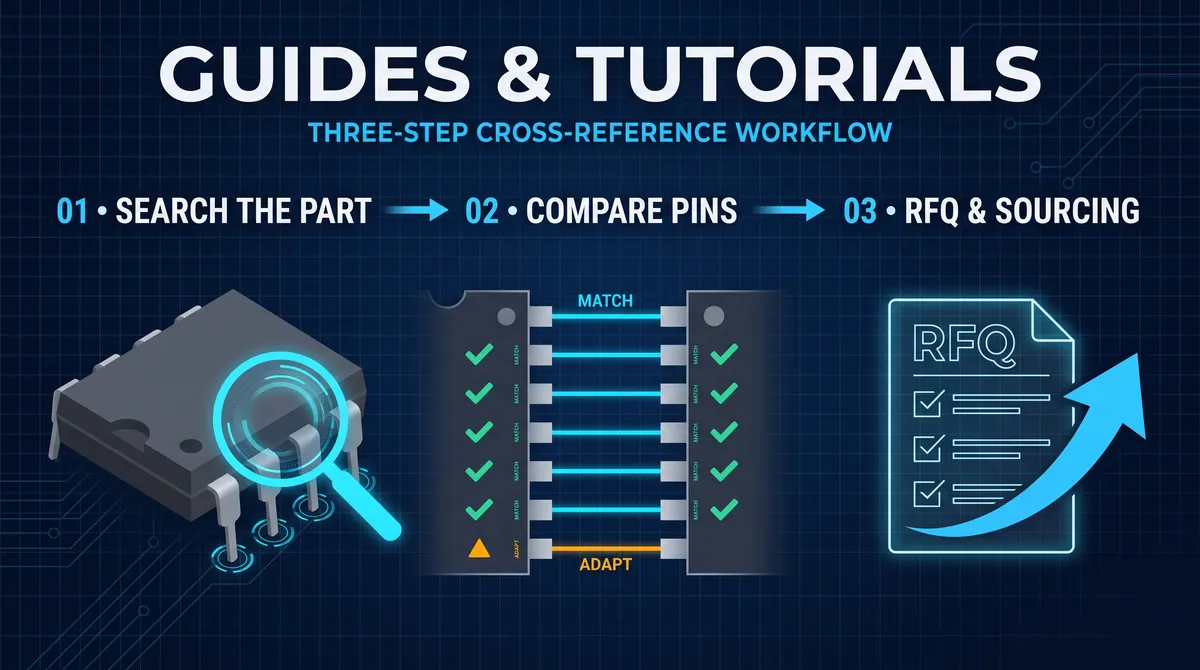
Obsolete IC replacement is a supply chain event that strikes the sensor vendor, the industrial controller builder, the medical device producer, and the hobbyist repair shop in exactly the same way: one day the part is on the shelf, and the next day the manufacturer has declared it end-of-life, the price has multiplied through a handful of remaining distributors, or the part number simply cannot be found at all. An obsolete IC is an integrated circuit that the original manufacturer has stopped producing, either because a newer product replaced it, because the process technology it was built on is no longer economical, or because the market for that specific function has moved on. The practical problem is not that the chip is gone, it is that the product built around it still needs to ship, and the board layout, the firmware, the test fixture, and often the certification all depend on that specific footprint. This guide walks every obsolete IC replacement decision through its three honest options, sourcing the original part from a specialist, substituting a compatible replacement that fits the same footprint, or redesigning the board around a current part, and it shows how to choose between them with evidence instead of panic.
The stakes of an obsolete IC replacement go far beyond the price of a chip. When a component goes end-of-life on a product that has been shipping for years, the entire lifecycle of that product is suddenly in scope: the installed base needs spares, the manufacturing line needs material for its remaining runs, and the engineering team needs to know whether the substitution can be done on the existing board or whether a new spin is required. Each option carries its own cost and risk, and the correct answer depends on the product's remaining lifetime, the availability of the original part in the legacy channel, the complexity of the board around the obsolete IC, and the team's tolerance for a qualification effort. Rushing this decision is expensive, which is why the professionals who handle obsolete parts well all run the same kind of structured review that this guide describes, starting from the end-of-life notice and ending at a documented, qualifiable plan.
What Makes an IC Obsolete and How to Spot It Early
An obsolete IC is an integrated circuit that the original component manufacturer (OCM) has discontinued from active production, and the official signals that mark that transition are standardized across the industry. The first signal is the product change notice, or PCN, which a manufacturer issues whenever it changes something that could affect a customer, including a die shrink, a package revision, or a move to a new test site, and a PCN deserves attention even before the part stops, because a tone can be the first step toward discontinuance. The second signal is the end-of-life notice, or EOL notice, which states the last order date and the last shipment date, and which opens a window commonly called the last-time-buy, during which customers can place final orders at the normal schedule. The third signal is the transition to mature or NRND (not recommended for new design) status in a product lifecycle, which tells designing engineers not to use the part in anything new even while fabrication continues. Together these signals give a disciplined supply chain months, and sometimes a year or more, between first learning a part is in decline and the final last-time-buy cutoff, and that lead time is the difference between handling the obsolescence as a plan and handling it as an emergency.
The lifecycle model behind these signals is worth understanding because it assigns the words used throughout this article. Products move from introduction to growth to maturity to decline, and semiconductor manufacturers publish lifecycle codes for this public classification: a part in growth or maturity is safe to design in, a part in decline is under watch, and a part marked end-of-life or NRND is the obituary. Buyers who watch the lifecycle codes of their critical parts, rather than reacting when a distributor's page turns to "no longer available," gain the planning horizon that makes obsolete IC replacement a routine exercise. The other critical early-warning habit is monitoring the availability itself: when a part that used to stock at three distributors suddenly shows only one source, when the distributor price rises, or when the datasheet's ordering page lists an end-of-life note, those are the same facts the buy-side analysts use to predict a discontinuance before the formal notice arrives. A team that reads these signals quarterly, rather than at stockout, is able to start the replacement work months ahead.
The Obsolete IC Replacement Decision: Source, Substitute, or Redesign
Every obsolete IC replacement decision is really a choice among three options, and the first disciplined step is to lay all three out before committing to one. The source option means finding the original part through the channel that still has it, whether that is an authorized distributor's remaining stock, a franchised legacy stock, an independent distributor that holds old inventory, or a broker that trades it. The substitute option means finding a pin-compatible or functionally equivalent replacement that mounts on the same board, which preserves the layout and the assembly process. The redesign option means accepting that no sourceable original and no compatible substitute exist and re-laying-out the board around a current-generation part. The correct choice is a function of three variables: how long the product still needs to ship, how much board complexity surrounds the obsolete part, and how available each replacement path is at the moment. A product nearing its own end can be carried to the finish with sourced stock; a long-lived product on a standard footprint gets a pin-compatible replacement; and a product with decades of life left on a proprietary pinout that nobody else copies gets the redesign.
The cost and risk of the three options are genuinely different, which is why the decision belongs to a documented review rather than to the loudest voice in the room. Sourcing preserves the exact part, which preserves everything downstream of it, but it carries the risk that the remaining stock is finite or that the source is a broker with unreliable authenticity, so the sourcing decision depends on traceability and test evidence. Substituting preserves the board but introduces the qualification risk of the new part, which is normally the smallest risk of the three because a pin-compatible part shares the footprint and the test program. Redesigning has the highest cost and the longest timeline, touching schematic, layout, firmware, prototype, certification, and manufacturing engineering, but it is also the only option that resets the lifecycle and removes the obsolete part from the BOM forever. A practical way to frame the trade-off is to estimate the cost per unit of extending the product's life under each option and to choose the option whose extension is cheapest at the volume the product actually ships.
Choosing which option by product lifetime and BOM complexity
Two variables carry most of the weight in the source-versus-substitute-versus-redesign decision. The first is the remaining product lifetime: if the product ships for six more months while a replacement qualification takes two months and a redesign takes ten, then even sourcing the last stock is clearly cheaper than starting a redesign the product will never amortize, while a product with a decade of support obligations in its contract almost always justifies the redesign. The second is the complexity of the board around the obsolete IC: a part that sits at the center of a dozen interface signals, an analog chain, and a firmware stack is far harder to substitute than a simple regulator in a standard footprint, so the redesign threshold moves down as the surrounding complexity moves up. Teams that keep these two variables visible make the whole discussion faster, because every stakeholder can see that the answer is not a matter of taste but a consequence of the product's remaining life and the board's fragility. When the analysis is genuinely close, the tiebreaker is the supply chain's confidence: a sourced part with a full test report from a trusted independent distributor outranks a substitute that has never been run on a production board, and a substitute that clears a sample qualification outranks a redesign that will consume next quarter's engineering budget.
How to Find a Replacement for an Obsolete IC
When a sourced original is not a durable answer, the search for an obsolete IC replacement starts the same way every component substitution starts, at the datasheet and the cross-reference, with the difference that the original datasheet may itself have disappeared from the manufacturer's site. The first move is to capture every piece of the part's identity from the package and the old datasheet: the exact part number including the package suffix, the function, the package type, and the key electrical parameters. The second move is to search the part number in a cross-reference database such as a dedicated replacement finder, an aggregation platform like Octopart or Findchips, or the alternate-part tables the manufacturers and independent distributors publish, and to collect the candidate list from more than one of these sources because each database has gaps. The third move is to qualify the candidates with the same three-layer review that defines pin compatibility, confirming the package, the pinout, and the electrical specifications against the original, so the replacement really is a drop-in rather than a part that happens to share a number family. The discipline matters most for obsolete parts because the forums are full of catalog mistakes where a "compatible" listing pointed at a part with a different pinout, and the teams that caught the errors all did so in the datasheet comparison, not in the search.
The search tactic for an obsolete part benefits from knowing how old parts are referenced. Older semiconductor families were often second-sourced by several manufacturers who used their own prefixes on the same base number, so a search that includes the generic family name, like 7805 or 555 or 74HC245, plus the words substitute or equivalent, reaches matches that an exact part-number search misses. Datasheet aggregator sites that archive discontinued documents are the reliable way to recover the original pinout when the manufacturer has purged it, and the archived datasheet is accepted evidence in most review processes precisely because it comes from the original document. Alongside the archive, the independent distributors of obsolete and hard-to-find components are a vertical source of the original part itself and of cross-reference notes their engineers have recorded on the same parts, and a distributor that ships a test report with a legacy part is worth more than a listing that exists only as a webpage. The habit that ties the whole search together is keeping the candidate list, because the next obsolete part on the same board will reuse the same relationships.
How to cross-reference obsolete and end-of-life part numbers
Part number conventions make cross-referencing obsolete parts more effective when the base family is understood first. A part number like STM32F103C8T6 encodes the family, the package, the flash size, and the temperature grade in its segments, so a cross-reference search that keeps the segment structure in mind filters out noise quickly. Cross-reference databases map part numbers to equivalents algorithmically and manually, and the best entries are the ones that carry a manufacturer note or a documented reason for the mapping, such as "pin-compatible, code-compatible per migration note." For a family like the STM32 line, the manufacturer's own migration guides and pin-compatibility matrices are the authoritative cross-reference, and an independent distributor of domestic alternatives will have turned those guides into stock: parts from GigaDevice, Artery, and similar vendors built to match the microcontroller pinout. The practical rule is the same as for any cross-reference, trust the manufacturer note above the aggregate listing, verify every candidate against the archived datasheet, and keep the verification record, because an obsolete part search that ends at a verified, documented replacement is exactly the outcome that keeps a production line running.
Lifecycle Signals and Last-Time-Buy Planning That Protect the Supply Chain
The professional answer to obsolete IC replacement is to make the end-of-life moment anticlimactic, and that only happens through last-time-buy planning that starts at the first signal. When an EOL notice arrives, the first calculation is the total demand the product still has: the remaining manufacturing forecast, the installed-base spare parts, and the service and repair stock, all summed into a final quantity that the last-time-buy order must cover or that a sourcing plan must satisfy over the remaining years. The second calculation is the rework risk, because buying a huge quantity of an obsolete part ties capital into inventory that is worthless the moment the product ends, so the buy quantity has to be balanced against the risk of sitting on dead stock. The third activity is parallel qualification: while the buy decision is being made, the team should already be qualifying a pin-compatible replacement, so that the production line has both the legacy stock and an exit path that does not depend on it. A last-time-buy handled this way converts an end-of-life notice from a freight train into a schedule.
The planning documents deserve the same discipline as the decision. Record the EOL notice, the last order date, and the last shipment date in the BOM's change log, and record the total buy quantity and the stocking location in the inventory plan. Cascade the notice to the design team so that no new design uses the part and to the service team so that spares planning covers the installed base. Run the quarterly lifecycle review that watches for the PCNs and the listing changes that predict the next discontinuance, so the next obsolete part is caught earlier than the last one. And where a product's BOM carries parts already in decline, bring the replacement qualification forward instead of waiting for the formal notice. The end result is a supply chain that treats obsolescence as a scheduled event with a known cost, which is as close to painless as obsolete IC replacement ever gets, and it is the standard the buyers and engineers who sleep well at night all share.
Sourcing Obsolete Parts: Independent Distributors, Brokers, and What Verifies Them
Sourcing is the option that keeps the exact part in production, and the channel that serves it deserves clear understanding because quality varies enormously. The authorized channel can hold residual stock of a recently discontinued part, which is usually the safest stock because it comes from the supplier relationship, but authorization ends with the part's life and the remaining shelf is limited. Independent distributors that specialize in obsolete and hard-to-find components are the backbone of the market: they buy end-of-life stock, hold legacy inventory acquired over decades, and buy from qualified sources, and the best of them operate test departments and ship parts with inspection evidence. Brokers who trade across the market can find almost anything and can equally trade almost anything, so the broker route demands the buyer's own verification discipline. The scorecard that separates a trustworthy obsolete source from a risky one is consistent across the industry: a published test capability, the certificates of conformance, the lot traceability, the availability of datasheets and cross-reference notes, and a willingness to answer engineering questions rather than only a price quote. On that scorecard, a specialist with a laboratory is a partner, and a broker without test evidence is a gamble.
The verification habits that protect the buyer are simple to rehearse. Order samples before volume, inspect the physical part against the expected markings, package, and date codes, and run the functional test that the product uses if the board allows it. For the risky categories of parts, the most likely to be remarked or recycled, add the destructive and nondestructive tests that counterfeit detection guides describe: decapsulation, X-ray, electrical testing against the original datasheet, and verification of the die pattern, and treat any sign of remarking as immediate rejection. Keep the test reports in the part change record, because the same evidence that qualified the part for a prototype qualifies it for production and because a documented verification trail is what survives an audit. The sourcing decision is therefore not done when the part arrives, it is done when the part passes the same three-layer check this guide applies everywhere: the part is the right device, it is authentic, and it is proven on the board.
Engineering Considerations When Replacing an Obsolete IC
The engineering review of an obsolete IC replacement concentrates on the differences the replacement introduces, and its shape is the same whether the replacement is a sourced original or a pin-compatible substitute. For a sourced original, the review focuses on the grade and the vintage: confirm the temperature grade, the package suffix, and the date code range match the assembly, and confirm the part has not been remarked or degraded in storage. For a pin-compatible substitute, the review covers the full three layers, the package and pinout from the archived original datasheet, the electrical parameters across the operating temperature range, and, for digital and microcontroller devices, the firmware and register behavior through a bring-up test. The risk that deserves independent attention is the interaction between an obsolete part and the rest of the board: an old part in a modern assembly frequently meets supply voltages, input levels, or bus speeds that did not exist when the part was designed, so the engineer should verify the replacement against the circuit as it is today, not against the app note from the original era. A substitution that passes the datasheet layers and a thermal stress pass is a substitution the production line can trust.
The engineering record is the deliverable that makes the replacement permanent. Document the original part and the reason for the change, the replacement decision among source, substitute, and redesign, the datasheet comparisons, the sample test results, and the qualification sign-off, and attach the lifecycle dates so the next reviewer sees the schedule. That record is what an ISO-managed change process requires and what a single-engineer shop values even more, because it turns tribal knowledge into a file on the shelf. It also creates the reusable pattern for the next obsolete IC: the library of cross-reference notes and test evidence built during one replacement shortens the next one, and a team that has qualified one pin-compatible replacement on a standard footprint can qualify the next family in days instead of weeks. The engineering intent is simple, replace the part without ever replacing the reliability, and the evidence trail is the mechanism that makes the intent real.
When Redesign Is the Right Answer for an Obsolete IC
Redesign is the last option, and it earns its place when the product's remaining life is long, the board around the obsolete part is complex, and no source or substitute can cover the horizon. The decision to redesign is entered when the cost of sourcing or substituting over the remaining product life exceeds the cost of a board revision, which normally happens with long-lived industrial, medical, and military products whose contracts run for years after the part disappears. The redesign itself starts from the same identity capture as a substitution, the part's function, its interface, and its role in the circuit, and proceeds to a current-generation part with full factory support, where the new part's datasheet, its roadmap, and its alternate sources are known quantities. The redesign then moves through the full engineering pipeline: schematic, layout, firmware where the MCU changes, prototype, EMC and safety validation, and the manufacturing engineering that updates the assembly program, and each stage closes with a review against the requirements the obsolete part used to meet. The timeline is measured in months, but the result is a BOM that has no end-of-life on it, which is the point.
The redesign also needs a transition plan that covers the gap, because the new board cannot meet the market before it is built. The transition plan runs the legacy product on sourced or substituted material while the new board is qualified, then steers volume to the new BOM while the legacy stock is consumed as spares, and finally retires the old build once the support obligations are satisfied. Sequencing the two is the operational art of the redesign: a line that switches too early wastes the legacy stock it paid for, and a line that switches too late carries the obsolete part's risk past the point where the new board was ready. The documented plan, the legacy inventory, the last-time-buy quantity, and the qualification schedule all belong in the same program sheet, so the transition is deliberate rather than improvised. Redesign is the most expensive answer to obsolete IC replacement, but for the product with years of life ahead of it, it is the cheapest answer per unit of survival, and the team that chooses it deliberately does so with the same evidence the sourcing and substitution decisions used.
Worked Example: Handling an Obsolete Operational Amplifier
Handling an obsolete operational amplifier is the worked example that shows the whole method on one part, and a retired dual op-amp on a running board is a case the market sees daily. The history is typical: the part has shipped in a product for years, the manufacturer issued the EOL notice with a last-time-buy window, and the product still needs the part for its remaining run. The first decision is the demand calculation, the remaining shipment forecast plus the spares and the service stock, and the result sets the last-time-buy quantity that covers the horizon with a buffer. The second decision is the parallel tracks: the buyer places the last-time-buy order at the normal price while the engineer qualifies a replacement, because the line should not depend on either the stock or the substitute alone. The replacement search finds a pin-compatible dual op-amp in the same SOIC-8, and the three-layer review compares the package, the pinout, and the electrical behavior, and the bench test runs the board's actual signal path across the temperature. The worked example resolves to the replacement qualifying cleanly, the last-time-buy carrying the bridge, and the board never changing, which is the best outcome the method produces. The example is the model for the handler, and it is the model the next sections' estimates build on.
The worked example also reads the cost of the paths, because the decision is economic as well as technical. The last-time-buy at the normal price costs the parts and the inventory holding, and the replacement qualification costs the samples, the bench time, and the documentation, and the redesign, had it been needed, would cost the engineering weeks. The example's numbers, a modest stock order and a short qualification, make the substitute the cheapest path, and the arithmetic is the same one that every obsolete part runs, the source, the substitute, and the redesign each priced against the horizon. The worked example is the concrete face of the method, and it is the face that the EOL notice and the decision tree turn into a schedule, which is the practical value the method delivers.
The Last-Time-Buy Calculation: A Worked Example
The last-time-buy calculation is the number that decides how much obsolete stock to carry, and a worked example makes the arithmetic concrete. Take a product that ships 500 units a month with an expected remaining life of two years, so the shipment demand is about 12,000 units, add the installed-base and service demand, about 500 spares a year for the existing fleet, 1,000 over the two years, and the base volume is about 13,000. Add the safety buffer, say 15 percent for the forecast uncertainty, and the last-time-buy quantity lands near 15,000 parts, which is the number that covers the horizon with the margin, and the record states the calculation so the review sees the reasoning. The discount comes next, because a product near its own end does not need the full buffer, and a long-lived product carries the full horizon, and the storage cost, the capital cost, and the obsolescence of the parts themselves, are weighed against the risk of the halt. The worked example shows the buffer leaning high when the halt is expensive and the product long-lived, and leaning lower when the product is near its end, and the balance is the last-time-buy decision.
The calculation also reads the parts where the buffer is not the answer, because a long product with a part that cannot be sourced in volume, or a part whose replacement is imminent, shifts the decision. If the replacement qualifies before the stock runs out, the buffer is wasted inventory, so the buyer watches the replacement's progress and trims the buy, and if the stock of the part is thin, the buy takes what the market holds and the buffer is whatever the pool allows. The last-time-buy is therefore a live decision, revisited as the replacement qualifies and the product's forecast moves, not a one-time order, and the worked example shows the revisit as part of the method. The last-time-buy calculation is the planning half of the obsolete handling, and it is the number that the sourcing and the replacement both schedule against.
How to Estimate the Cost of Each Obsolete Option
Estimating the cost of each obsolete option is the economic half of the decision, and the three options price differently against the horizon. The source option costs the market price of the remaining stock, which rises as the pool draws down, plus the inventory holding and the risk of the counterfeit or the failed lot, and it is the cheapest when the part is fresh and the pool is full, and the most expensive when the part is scarce. The substitute option costs the qualification, the samples, the bench time, the documentation, and the per-unit price of the replacement, and it is the cheapest when a pin-compatible part exists and the qualification is short, and the most expensive when the candidate needs the porting or the adapter. The redesign option costs the engineering weeks, the prototype, the validation, and the new BOM, and it is the most expensive in the near term and the only option that resets the lifecycle and removes the obsolete part forever. The estimate is a table across the options, the cost, the timeline, the risk, and the horizon, and the table is the frame the decision is made on, which is the same economic frame the worked example demonstrated.
The estimate also reads the risk terms that the prices do not capture, because the options carry different failure modes. The source carries the risk that the stock is counterfeit or the lot fails, and the verification cost is part of its price. The substitute carries the risk that the qualification misses a marginal behavior, and the soak test is part of its price. The redesign carries the risk that the new board introduces a defect or a delay, and the pilot run is part of its price. The buyer who prices the options with the risk and the verification included compares the total cost rather than the quote, and the comparison is the economic method. The cost estimate is the number behind the source, substitute, or redesign decision, and it is the number the decision tree and the approval both use, which is the completion of the economic half of the obsolete handling method.
Documentation and the Change Record for an Obsolete Part
The documentation of an obsolete part is the record that the decision left behind, and it is the artifact the next reviewer and the next audit read. The change record carries the part number, the reason for the change, the EOL notice and its dates, the lifecycle status, and the decision among the source, the substitute, or the redesign, with the evidence, the last-time-buy calculation, the quotes, the verification test data, and the sign-off. The record also carries the sourcing history, the suppliers, the certificates, the traceability, and the inventory the buy placed, and the replacement history, the candidate, the qualification, and the transition plan, so the whole obsolete event is one readable file. The documentation is the difference between an obsolete part that is a managed event and one that is a string of oral memories, and the file is the difference the next line of engineers inherits. The change record is the standard deliverable of the obsolete handling, and it is the deliverable that this guide's method always produces.
The record also feeds the library that makes the next obsolete part easier, because the cross-reference notes, the verification records, and the qualified suppliers that one obsolete event produced are facts the next event reuses. The buyer who files the source list finds the next scarce part faster, and the engineer who files the pin-compatibility check finds the next replacement faster, and the library compounds. The change record is therefore not the close of the event but the seed of the next, and the documentation habit is the discipline that turns obsolete handling from a repeated scramble into a growing competence. The record is the final section of the method, and it is the section that the workflow then executes in order.
A Practical Obsolete IC Replacement Workflow
The full obsolete IC replacement process condenses into a workflow that any team, from a single engineer to a global supply chain, can run in the same order. First, capture the part's identity and request the archived datasheet when the manufacturer has removed it. Second, watch the lifecycle signals, the PCNs, the EOL notices, and the availability changes, and open the review the moment a signal appears rather than at stockout. Third, run the three-option analysis: source the original from a verified specialist, substitute a pin-compatible or equivalent alternative qualified on the three layers, or redesign around a current part when the product life demands it, and choose on the evidence of remaining product life and board complexity. Fourth, run parallel tracks, place the last-time-buy or the sourcing order while simultaneously qualifying the substitute, so the line never depends on a single outcome. Fifth, verify, samples through the product test and the thermal stress pass, with the counterfeit checks on the risky parts, and record every comparison and test result. Sixth, update the BOM and the records, the change notice, the lifecycle dates, and the cross-reference library, so the next obsolete part inherits the beat path. That sequence turns the scariest word in component management, obsolete, into a calendar event with a known answer.
The workflow is also the reason this article exists as a guide rather than as a lookup table. Obsolete IC replacement is not one answer, it is a system of trade-offs, between original stock and compatible substitute, between board preservation and reset lifecycle, between schedule and verification, and every product resolves those trade-offs differently. What the workflow provides is the discipline that the resolution is documented, the evidence is kept, and the next decision starts from the last one. A buyer and an engineer who run this workflow together take an end-of-life notice, an obsolete part, and a raised voice, and return a plan with a source, a substitute, and a date, and that plan is what a production line needs to keep shipping.
Not sure which sensor fits your project?
Talk to our mmWave application engineers for a free consultation.
Specify your hotel project with our engineers
Send your room count, ceiling type, and protocol preference. We will return a sample plan and quote within 24 business hours.
- Move from general guidance into a product or application discussion.
- Use RFQ when pricing, drawings, MOQ, or launch timing needs structure.
- Keep a direct contact path visible for fast clarifications and handoff.