RS485 Transceiver Cross Reference: Replacing MAX485 in Industrial Control Systems
A comprehensive guide to selecting and implementing RS485 transceiver replacements for MAX485 in industrial automation applications, covering cross-reference options, pin compatibility, and selection criteria.
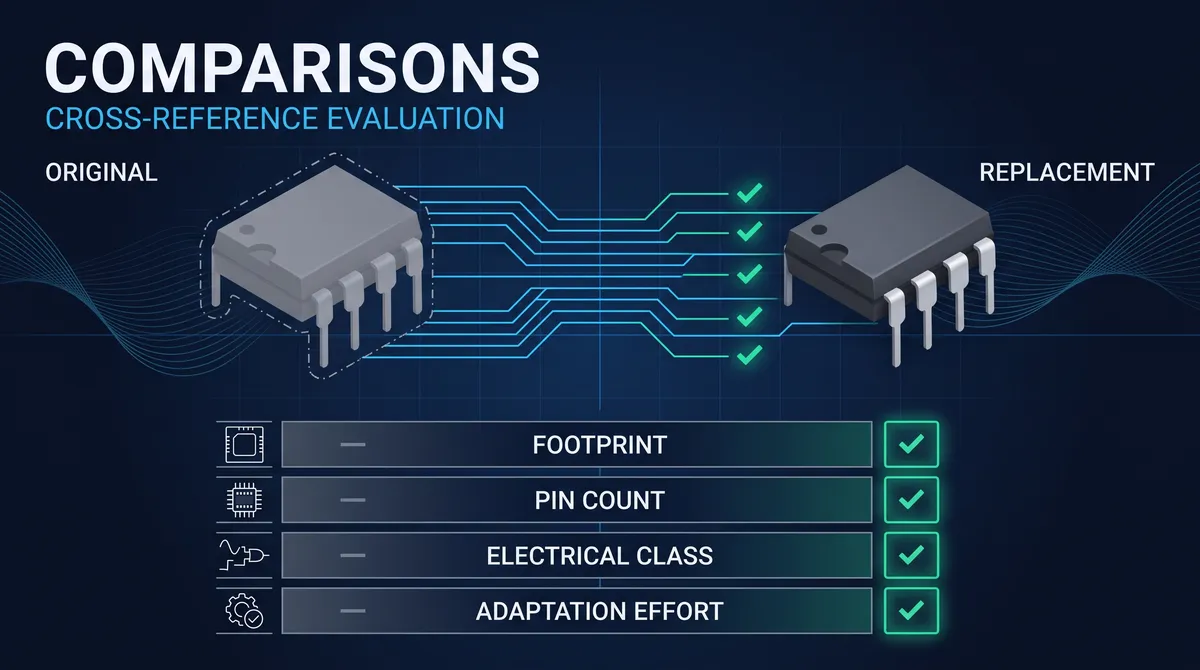
RS485 Transceiver Cross Reference: Replacing MAX485 in Industrial Control Systems
The MAX485 transceiver has long served as a foundational component in industrial control systems, providing the critical differential signaling interface that enables robust half-duplex communication across factory floors, process automation networks, and building management systems. Introduced by Maxim Integrated (now part of Analog Devices), this 8-pin RS485 transceiver became the de facto standard for cost-effective industrial communication due to its reliable performance, manageable thermal characteristics, and widespread availability at attractive price points. However, as industrial environments increasingly demand higher data rates, improved electromagnetic compatibility, larger network sizes, and enhanced protection against transients and electrostatic discharge, engineers and procurement specialists face the growing challenge of identifying suitable MAX485 replacement options that maintain backward compatibility while delivering upgraded performance capabilities. This RS485 transceiver replacement guide addresses that challenge directly, providing a systematic methodology for evaluating cross-reference alternatives, understanding critical parametric differences, and implementing successful component substitutions in mission-critical industrial control applications.
Understanding RS485 Transceiver Architecture and Industrial Requirements
The RS485 standard, formally defined as EIA-485, specifies a balanced differential signaling scheme that enables communication distances up to 1,200 meters at data rates up to 10 Mbps, though practical deployments typically balance these parameters based on specific application requirements. An RS485 transceiver serves as the physical interface between a microcontroller or processor's UART signals and the differential bus that connects multiple nodes across an industrial network, converting single-ended transmit and receive signals into differential voltage pairs that exhibit strong common-mode rejection characteristics essential for operation in electrically noisy environments. The typical RS485 transceiver contains a differential driver for transmitting data onto the bus, a differential receiver for capturing incoming data, and control logic that manages the direction of operation in half-duplex configurations where the same wire pair must serve both transmission and reception functions. Industrial control systems commonly deploy RS485 networks in topologies that daisy-chain multiple instruments, programmable logic controllers, variable frequency drives, and human-machine interfaces across a shared bus, with termination resistors placed at the physical extremes of the network to prevent signal reflections that would otherwise degrade communication reliability.
Industrial environments impose demanding requirements on RS485 transceivers that exceed the capabilities of commercial-grade alternatives designed for office or laboratory use. Electromagnetic interference generated by motor drives, switching power supplies, and radio frequency equipment can couple into communication cables and corrupt data signals unless the transceiver provides adequate common-mode rejection, typically specified as receiver input sensitivity of ±200 millivolts or better. Transient voltage spikes and electrostatic discharge events that commonly occur during cable installation, maintenance activities, or lightning-induced surges demand transceiver protection circuits capable of withstanding surge events exceeding 1 kilovolt without sustaining permanent damage. Temperature operation across the full industrial range from minus 40 degrees Celsius to plus 85 degrees Celsius ensures reliable performance in unconditioned facilities, outdoor installations, and equipment enclosures where thermal management is limited. The half-duplex communication mode prevalent in industrial applications requires transceivers with driver enable times and propagation delays optimized for rapid turnaround between transmit and receive states, particularly in systems employing multi-drop addressing schemes where the controller must rapidly query numerous distributed nodes.
MAX485 Specifications, Performance Boundaries, and Lifecycle Considerations
The MAX485 transceiver, manufactured in both the original Maxim version and subsequent pin-compatible equivalents from multiple semiconductor suppliers, implements a half-duplex RS485 interface in an 8-pin DIP or SOIC package that has become ubiquitous across industrial, commercial, and consumer electronics applications. The device operates from a single 5-volt supply and provides a driver output current of 60 milliamps, enabling the creation of differential bus voltages exceeding 1.5 volts under load while maintaining compliance with the RS485 standard's minimum differential output requirement of 1.5 volts under load conditions specified for 54-ohm termination. Receiver input sensitivity meets the RS485 specification at 200 millivolts, meaning the device reliably detects differential signals exceeding this threshold as valid logic levels while rejecting smaller differential voltages as noise. The MAX485 supports data rates from DC to 2.5 megabits per second, with the maximum rate limited by the device's propagation delay of approximately 50 nanoseconds, which constrains the minimum bit time to roughly 10 times the propagation delay for reliable operation at the target bit error rate.
Several performance limitations of the MAX485 become increasingly significant as industrial system requirements evolve toward higher performance and stricter reliability standards. The device lacks built-in protection against electrostatic discharge beyond basic input diodes, leaving the bus interface pins vulnerable to damage from handling and installation events that generate discharge events exceeding the 2 kilovolts typical for human body model discharge. The absence of thermal shutdown protection means the driver can enter a latch-up condition if bus contention or excessive loading causes the output stage to dissipate power beyond its safe operating area, potentially destroying the device or creating hazardous conditions in enclosed equipment. The MAX485's driver output current of 60 milliamps limits the number of receivers that can share a common bus segment, particularly when using transceivers with lower input impedance that draw higher currents from the differential bus. For applications requiring operation at the RS485 maximum data rate of 10 Mbps, the MAX485's slower propagation characteristics and limited drive strength necessitate careful attention to network topology, cable selection, and termination practices that may constrain design flexibility.
Supply chain dynamics have increasingly influenced the selection of MAX485 and its equivalents, with extended lead times, allocation policies, and price volatility prompting engineers to evaluate alternative devices that offer functional equivalence with improved availability. While the MAX485 remains a mature product with stable manufacturing capacity, the consolidation of semiconductor suppliers through acquisitions and the migration of production to more advanced process technologies has created opportunities for alternative suppliers to offer pin-compatible replacements with equivalent or improved specifications. This RS485 transceiver replacement guide focuses specifically on identifying those alternatives that can serve as direct drop-in replacements for the MAX485 in existing designs while providing additional margin in critical performance areas that enhance system reliability and extend operational lifetime.
Systematic Methodology for RS485 Transceiver Cross-Reference Evaluation
Effective evaluation of MAX485 replacement candidates requires a systematic approach that balances technical compatibility requirements with practical considerations including second-source availability, long-term supply assurance, and total cost of ownership across the product lifecycle. The first phase of cross-reference evaluation establishes the non-negotiable requirements that any replacement candidate must satisfy, including pin compatibility for drop-in replacement without PCB modifications, electrical specifications that meet or exceed the original device's performance, and package options that are compatible with the existing assembly processes and board layout. These fundamental requirements narrow the candidate pool to devices that can physically replace the MAX485 without engineering changes, reducing qualification effort and enabling rapid deployment in production environments where schedule constraints may preclude design modifications.
The second phase of evaluation addresses parametric improvements that enhance system performance beyond the baseline established by the MAX485, providing margin against environmental variations, aging effects, and edge-case operating conditions that may not be apparent during initial design but can manifest during extended field operation. Enhanced electrostatic discharge protection exceeding 15 kilovolts per the IEC 61000-4-2 standard eliminates a common failure mode in industrial environments where personnel frequently handle cables and connectors. Thermal shutdown protection prevents damage from bus contention conditions that can occur during system startup, fault recovery, or improper wiring. Improved receiver input filtering reduces susceptibility to common-mode noise that is prevalent in industrial facilities with high electromagnetic field strength. Higher driver output current enables larger network sizes with more receivers sharing the bus while maintaining adequate differential voltage margins. These improvements provide engineering margin that increases system reliability and extends the operational lifetime of industrial control equipment.
The third phase of evaluation considers commercial and supply chain factors that influence the viability of each candidate as a long-term MAX485 replacement. Multiple suppliers offering pin-compatible devices reduce the risk of supply disruption from production capacity issues, natural disasters, or geopolitical factors that can affect any single manufacturer. Extended product lifecycle guarantees from the supplier provide confidence that the replacement component will remain available throughout the expected life of the industrial equipment being designed or maintained. Packaging options including Pb-free variants for RoHS compliance and industrial temperature grade variants for harsh environment applications ensure the replacement meets the environmental requirements of the target application. Pricing structure and volume discount availability influence total cost, particularly for high-volume production applications where component cost dominates the bill of materials. This comprehensive evaluation framework enables informed selection of RS485 transceiver alternatives that satisfy immediate replacement requirements while providing strategic advantages for long-term product support.
Pin-to-Pin Compatible RS485 Transceiver Alternatives
The SN75176B from Texas Instruments represents one of the earliest and most widely accepted pin-compatible alternatives to the MAX485, offering equivalent electrical specifications in a package that enables direct drop-in replacement in most applications. The SN75176B operates from a single 5-volt supply and provides driver output current of 60 milliamps with propagation delay specifications that match the MAX485's 50-nanosecond typical value, enabling reliable half-duplex communication at data rates up to 2.5 megabits per second. Receiver input sensitivity of 200 millivolts ensures compatibility with the full range of RS485-compliant devices on the bus, while the 1/2-unit-load input impedance allows connection of up to 32 unit loads on a single bus segment in compliance with the RS485 standard. The SN75176B has been manufactured by multiple semiconductor suppliers under various part number prefixes, creating a robust second-source ecosystem that reduces supply risk and enables competitive pricing across production volumes.
The MAX13487 and MAX13488 from Maxim Integrated (now Analog Devices) offer enhanced versions of the MAX485 architecture with integrated features that address common application requirements without sacrificing pin compatibility. The MAX13487 adds a hot-swap capability that prevents bus disturbances during live insertion of a node into an active network, a critical requirement in modular systems where boards may be inserted or removed during operation. The MAX13488 includes the hot-swap feature plus a receiver output timeout function that prevents the receive output from hanging at an indeterminate logic level when the bus is undriven for extended periods, simplifying the interface to microcontrollers that lack internal pull-up resistors on their UART inputs. Both devices maintain the same pinout, package options, and electrical specifications as the MAX485 while adding protection features that enhance system robustness in demanding industrial environments.
The SP3485 from MaxLinear (formerly Sipex) provides excellent pin compatibility with the MAX485 while offering improved performance in several key areas including electrostatic discharge protection, thermal performance, and data rate capability. The SP3485 features human body model ESD protection of 15 kilovolts on the bus pins, significantly exceeding the basic protection provided by the MAX485 and eliminating a common cause of field failures in industrial installations. The device operates from a 5-volt supply and provides driver output current of 60 milliamps with propagation delay specifications that enable reliable communication at data rates up to 10 megabits per second, twice the maximum rate achievable with the MAX485. This increased bandwidth provides flexibility for system upgrades that require higher communication speeds without hardware modifications, making the SP3485 an attractive choice for applications where future bandwidth expansion is anticipated. The SP3485 is available in multiple package options including SOIC and DIP, ensuring compatibility with existing board layouts and assembly processes.
Enhanced Performance RS485 Transceiver Alternatives with Improved Specifications
The ADM2587E from Analog Devices represents a significant advancement in RS485 transceiver technology, integrating isolated DC-to-DC converter functionality that eliminates the need for external isolation components while maintaining a pin-out that facilitates replacement of the MAX485 in many applications. This fully integrated solution provides 2500-volt RMS isolation between the logic-side circuitry and the bus-side interface, protecting sensitive control electronics from ground loops, common-mode voltage transients, and electrical noise that commonly affect industrial communication networks. The integrated isolated power supply simplifies the bill of materials and reduces board space requirements, while the robust isolation rating meets the stringent requirements of industrial safety standards including IEC 61000-4-2 for electrostatic discharge, IEC 61000-4-3 for radiated immunity, and EN 55022 for conducted and radiated emissions. The ADM2587E operates at data rates up to 16 megabits per second, providing substantial headroom beyond the MAX485's 2.5 megabit capability.
The ISL3152E from Renesas Electronics offers enhanced performance with extensive protection features specifically designed for demanding industrial environments, including ±15 kilovolt contact discharge ESD protection, ±15 kilovolt air gap discharge ESD protection, and ±8 kilovolt human body model protection that exceeds the capability of the standard MAX485 by a factor of four or more. The device features true fail-safe receiver inputs that guarantee a known logic output state when the bus is idle or shorted, eliminating an ambiguity condition that can cause communication failures in systems with marginal bus biasing. Thermal shutdown protection prevents damage from excessive power dissipation during bus contention conditions, providing a safety mechanism that the MAX485 lacks entirely. The ISL3152E operates from a 5-volt supply and provides driver output current of 60 milliamps with data rate capability up to 115 kilobits per second, making it suitable for most standard industrial communication protocols including Modbus RTU and PROFIBUS applications.
The THVD1500 from Texas Instruments combines robust industrial protection with excellent performance specifications in a pin-compatible package that enables straightforward replacement of the MAX485 in applications requiring enhanced reliability. The device provides IEC 61000-4-2 ESD protection of ±18 kilovolts for contact discharge, ±18 kilovolts for air gap discharge, and ±18 kilovolts for human body model testing, representing some of the highest protection levels available in standard RS485 transceivers. The THVD1500 features a wide supply voltage range of 3.3 to 5 volts, providing flexibility for systems that have migrated from 5-volt to 3.3-volt logic while maintaining compatibility with legacy equipment. The driver output current of 60 milliamps and receiver input sensitivity of 50 millivolts exceed the RS485 standard requirements, providing enhanced noise margin for reliable operation in environments with high electromagnetic interference. The device supports data rates up to 1 megabit per second, adequate for the vast majority of industrial automation protocols.
Comparative Analysis: Selecting the Optimal RS485 Transceiver Replacement
The selection of an optimal RS485 transceiver replacement depends critically on the specific requirements of the target application, with different alternatives offering distinct advantages across the dimensions of performance, protection, compatibility, and cost. For applications that require direct drop-in replacement without any design modifications, the pin-compatible alternatives including the SN75176B, SP3485, and MAX13487 provide the lowest-risk path to component substitution while offering incremental improvements in specific areas. The SN75176B offers the longest history of proven reliability and the widest availability of second sources, making it an excellent choice for applications where supply continuity is the primary concern. The SP3485 provides improved ESD protection and higher data rate capability for applications that may need to support faster communication in the future. The MAX13487 and MAX13488 add hot-swap capability and receiver timeout functions that address specific application requirements without sacrificing compatibility.
For applications in harsh industrial environments where protection against transients and electrostatic discharge is paramount, the enhanced alternatives including the ISL3152E, THVD1500, and ADM2587E offer substantial improvements in robustness that can significantly extend equipment lifetime and reduce field failure rates. The ISL3152E provides the best combination of ESD protection and fail-safe receiver operation, making it ideal for applications in manufacturing facilities with high static discharge potential or environments with variable ground potentials. The THVD1500 offers the highest IEC 61000-4-2 protection levels available, making it suitable for applications in lighting control systems, motor drives, or other environments with severe electromagnetic disturbances. The ADM2587E provides integrated isolation that eliminates external isolation components and their associated reliability challenges, making it the preferred choice for applications requiring isolation beyond the basic protection provided by non-isolated transceivers.
Cost considerations influence the selection of RS485 transceiver replacements, with unit pricing varying significantly across the range of available alternatives based on integrated features, protection levels, and supplier positioning. Standard pin-compatible alternatives such as the SN75176B and SP3485 typically trade at prices comparable to the MAX485, with the SP3485 commanding a modest premium for its enhanced ESD protection and higher data rate capability. Enhanced alternatives with extensive protection features such as the ISL3152E and THVD1500 command higher prices reflecting their extended capabilities, with the per-unit cost offset by reduced field failure rates and warranty expenses in demanding applications. The ADM2587E's integrated isolation eliminates the cost of external isolation components including optocouplers, isolated power supplies, and associated discrete components, potentially reducing total system cost despite the higher per-unit price of the transceiver itself.
Implementation Considerations for MAX485 Replacement in Existing Systems
Successful replacement of the MAX485 in existing industrial control systems requires careful attention to several practical considerations that can affect system operation if not properly addressed. The first consideration involves verification of mechanical compatibility including package dimensions, pin spacing, and lead finish to ensure the replacement device will physically fit the existing PCB footprint without interference from adjacent components or mechanical constraints such as board guides or enclosure features. While most pin-compatible alternatives use standard packages including SOIC-8 and DIP-8, subtle differences in lead coplanarity, package height, or thermal characteristics may require adjustment of solder paste volumes, reflow profiles, or inspection criteria to achieve reliable solder joints. For production environments with existing assembly processes, sourcing a replacement that matches the original device's package style minimizes the effort required to qualify the alternative component.
Electrical verification should confirm that the replacement transceiver meets all signal timing requirements specified by the communication protocol in use, particularly for systems operating at high data rates or with strict timing constraints on turnaround delays between transmit and receive modes. While most pin-compatible alternatives provide propagation delay specifications comparable to the MAX485, the specific distribution of propagation delay between rising and falling edges and the driver enable and disable times can vary between manufacturers, potentially affecting communication reliability in timing-sensitive protocols. Oscilloscope measurements of actual signal waveforms during system operation can identify timing margins that may be affected by transceiver substitution, enabling compensation through protocol parameter adjustments if necessary. For systems with marginal timing margins, selecting an alternative with tighter propagation delay specifications provides additional safety margin against variations in temperature, supply voltage, and manufacturing tolerances.
Thermal considerations become more important for replacement transceivers with enhanced output current capability or higher data rate operation, both of which increase power dissipation compared to the original MAX485. The thermal resistance from junction to ambient for the replacement package determines the maximum operating temperature at which the device can deliver rated performance without entering thermal shutdown, and this should be evaluated against the actual thermal environment in the target application including nearby heat sources, airflow characteristics, and any enclosure thermal
Regulatory Compliance and Industrial Certification Requirements
Industrial control systems sold in global markets must comply with various regulatory requirements and industry standards that can influence the selection of RS485 transceiver replacements, with different regions and applications imposing distinct requirements for electromagnetic compatibility, safety, and environmental protection. The European Union's RoHS directive restricts the use of certain hazardous substances including lead in electronic equipment, requiring replacement transceivers to be available in Pb-free packages with appropriate finish materials such as matte tin or silver-palladium-platinum-gold to ensure compliance. Most contemporary RS485 transceiver alternatives are available in RoHS-compliant versions, but verification of the specific part number suffix indicating Pb-free construction is essential for applications destined for European markets. The REACH regulation addressing chemical registration and authorization may impose additional requirements depending on the specific compounds used in transceiver manufacturing, though standard semiconductor packages generally satisfy REACH requirements through their minimal use of restricted substances.
Electromagnetic compatibility requirements enforced by regulatory agencies in the European Union, United States, and other jurisdictions establish limits on conducted and radiated emissions from electronic equipment as well as minimum immunity levels against electromagnetic disturbances. The RS485 transceiver itself does not typically constitute a significant emission source, but the communication cables connected to the transceiver can act as antennae that radiate signals from the differential bus, potentially exceeding emission limits in sensitive applications. Replacement transceivers with enhanced common-mode rejection and reduced output edge rates can help minimize high-frequency components that contribute to cable radiation, improving the overall electromagnetic signature of the system. For equipment requiring formal EMC certification, testing with the replacement transceiver should be performed to verify compliance with applicable limits, as changes to the transceiver can affect the system's emission and immunity characteristics.
Industry-specific standards may impose additional requirements on RS485 transceivers used in particular applications, with standards such as those from the American Petroleum Institute for petroleum industry automation or the International Society of Automation for process control providing guidance on acceptable component specifications and qualification requirements. These industry standards often reference generic requirements from the RS485 standard for fundamental electrical characteristics while adding application-specific requirements for environmental operation, corrosion resistance, or performance under fault conditions. Replacement transceivers should be evaluated against the relevant industry requirements for the target application, with particular attention to extended temperature ranges, enhanced protection against specific failure modes, and documentation requirements for traceability and qualification records.
Common Pitfalls and Troubleshooting Strategies
Despite the apparent simplicity of replacing a pin-compatible RS485 transceiver, several common pitfalls can cause unexpected communication failures or reliability issues if not properly anticipated and addressed during the replacement process. The first pitfall involves subtle differences in receiver input characteristics that affect the behavior of the bus when no driver is actively transmitting, a condition that occurs frequently in half-duplex systems where nodes must tri-state their drivers between transmissions. The MAX485 and most compatible alternatives implement receiver biasing that pulls the differential input to a known state when the bus is undriven, but the specific bias voltage and input impedance can vary between manufacturers, potentially affecting the time required for the receiver output to reach a defined logic level after the driver disables. This variation can cause timing problems in protocols that require rapid turnaround between transmit and receive operations, manifesting as intermittent communication failures or reduced noise immunity during bus transition periods.
A second common pitfall involves inadequate consideration of protection requirements when replacing a standard MAX485 with an alternative that lacks sufficient protection for the target environment. While the MAX485 itself provides only basic ESD protection, some replacement alternatives have been selected for cost optimization rather than enhanced protection, potentially leaving the system more vulnerable to damage from electrostatic discharge, electrical transients, or other environmental stressors. Systematic evaluation of the replacement candidate's protection specifications against the actual environmental requirements of the application ensures that adequate protection is maintained through the component substitution. For applications in harsh environments, selecting alternatives with enhanced protection specifications provides margin against protection failures that can result in costly field failures and warranty expenses.
The third pitfall involves overlooking subtle differences in power supply requirements that can affect system reliability or cause premature failures during extended operation. Some RS485 transceiver alternatives include additional internal circuits such as thermal shutdown circuits, output enable logic, or protection clamping networks that draw quiescent current beyond the typical 500-microamp specification of the standard MAX485. While the incremental current consumption is typically modest, it can affect total power budget calculations in battery-powered or solar-powered systems where current consumption is tightly constrained. More significantly, differences in power supply rejection characteristics can affect susceptibility to noise on the supply rails, potentially causing communication errors in systems with noisy power supplies or inadequate supply filtering. Thorough review of the electrical specifications for each replacement candidate ensures that the target application's power supply configuration can properly support the replacement device.
Future-Proofing Industrial Communication Systems
As industrial communication requirements continue to evolve toward higher data rates, increased network complexity, and enhanced diagnostic capabilities, the selection of RS485 transceiver replacements should consider not only current requirements but also anticipated future needs that may influence system evolution. Systems designed today may need to support higher bandwidth protocols in the future as more data-intensive devices are added to the network or as applications migrate from legacy protocols to more capable alternatives. Selecting replacement transceivers with higher maximum data rate capability than currently required provides headroom for future protocol upgrades without hardware modifications, extending the useful life of the communication infrastructure and reducing lifecycle costs. The SP3485's 10 megabit per second capability and the ADM2587E's 16 megabit per second capability exemplify this forward-looking approach to transceiver selection.
The continued development of industrial Ethernet protocols including EtherNet/IP, PROFINET, and Modbus TCP has created demand for communication infrastructure that can bridge between traditional RS485 networks and Ethernet-based systems, enabling gradual migration strategies that preserve existing field-level investments while introducing modern connectivity capabilities. RS485 transceivers that interface with protocol converters, gateways, or edge computing devices may need to operate continuously at high data rates to support the elevated throughput requirements of these hybrid architectures. Replacement transceivers selected for such applications should provide the headroom necessary to accommodate not only current throughput requirements but also the increased traffic that typically accompanies integration of legacy and modern communication systems.
Supply chain resilience has emerged as a critical consideration in component selection as industrial organizations seek to reduce their vulnerability to semiconductor shortages, shipping disruptions, and geopolitical uncertainties that can affect component availability. Strategies for enhancing supply chain resilience include dual-sourcing from multiple manufacturers, maintaining strategic inventory buffers, and selecting components with multiple compatible alternatives that can serve as emergency substitutes if the primary source becomes unavailable. The availability of multiple pin-compatible alternatives for the MAX485 from different manufacturers provides a foundation for supply chain diversification that can be leveraged to reduce risk and ensure continuity of production for industrial control systems.
Summary: Key Takeaways for RS485 Transceiver Selection
The replacement of MAX485 transceivers in industrial control systems requires a balanced evaluation approach that considers technical compatibility, performance enhancement, protection requirements, and supply chain factors to identify the optimal alternative for each specific application. Pin-compatible alternatives including the SN75176B, SP3485, and MAX13487 series provide the lowest-risk path to component substitution, maintaining drop-in compatibility while offering incremental improvements in ESD protection, data rate capability, or functional features. Enhanced alternatives including the ISL3152E, THVD1500, and ADM2587E address demanding industrial requirements with extensive protection features, improved thermal characteristics, and integrated functionality that can enhance system reliability and reduce total system cost despite higher per-unit pricing.
The systematic evaluation methodology presented in this RS485 transceiver replacement guide enables engineering teams and procurement specialists to navigate the complex trade-offs between competing alternatives and select components that best satisfy the specific requirements of their target applications. By establishing clear evaluation criteria, prioritizing requirements based on application-specific factors, and verifying compatibility through appropriate testing and qualification activities, organizations can achieve successful component substitutions that maintain system reliability while providing margin against future requirements and supply chain challenges. The breadth of available alternatives ensures that an appropriate replacement exists for virtually every MAX485 application, from cost-sensitive production applications requiring simple functional equivalence to mission-critical industrial installations demanding the highest levels of protection and performance.
Not sure which sensor fits your project?
Talk to our mmWave application engineers for a free consultation.
Specify your hotel project with our engineers
Send your room count, ceiling type, and protocol preference. We will return a sample plan and quote within 24 business hours.
- Move from general guidance into a product or application discussion.
- Use RFQ when pricing, drawings, MOQ, or launch timing needs structure.
- Keep a direct contact path visible for fast clarifications and handoff.