Second Source Chips: How to Diversify Your IC Supply Chain and Reduce Sourcing Risk
Learn how second source chip supplier diversification helps electronics manufacturers reduce IC supply chain risk and ensure production continuity with proven strategies.
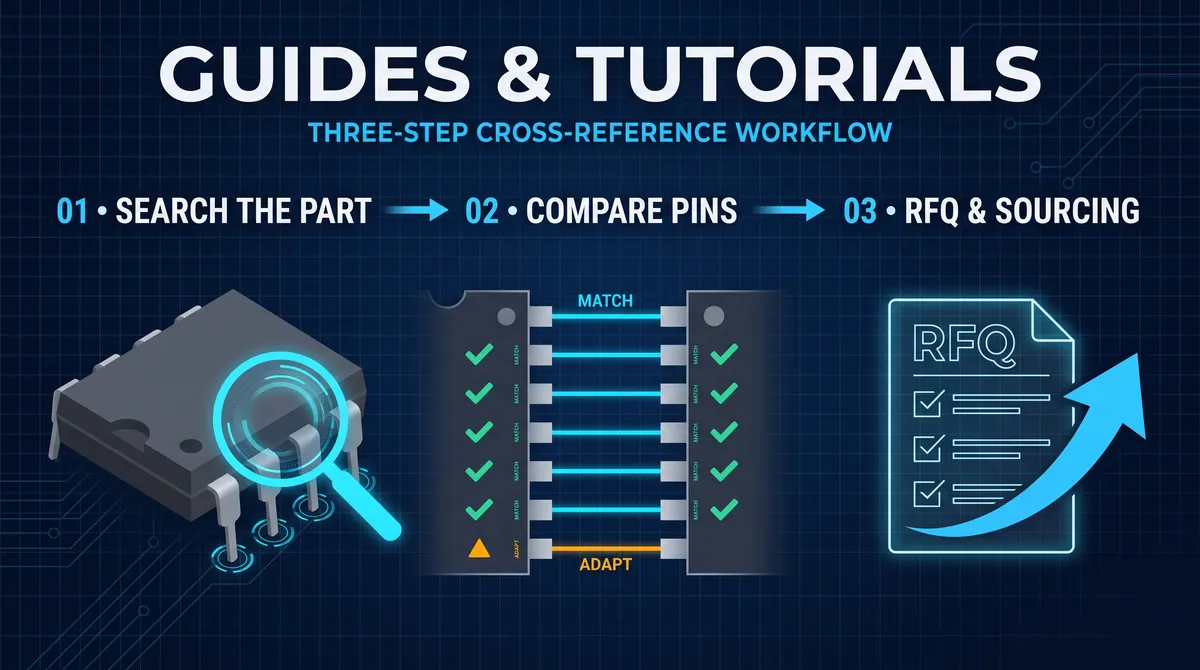
Second Source Chips: How to Diversify Your IC Supply Chain and Reduce Sourcing Risk
Understanding Second Source Chip Supplier Diversification
Second source chip supplier diversification is a strategic procurement practice where electronics manufacturers identify, qualify, and maintain relationships with multiple independent suppliers for the same integrated circuit component or chip family. This approach transforms a traditional single-source procurement model into a resilient supply chain architecture where alternative qualified vendors can fulfill production requirements if a primary supplier experiences disruption. Industry analysis from the Semiconductor Industry Association indicates that approximately 73% of electronics manufacturers with annual revenues exceeding $100 million have formalized second source programs, reflecting the critical nature of supply chain redundancy in modern chip procurement. The core mechanism involves establishing technical equivalence between components from different manufacturers, ensuring that secondary suppliers meet identical specifications for pinout, electrical characteristics, thermal performance, and package dimensions. Diversification strategies typically span multiple geographic regions and supplier tiers to mitigate concentration risk from geopolitical factors, natural disasters, or manufacturing capacity constraints that could simultaneously affect multiple sources within a single region.
The rationale for implementing second source chip supplier diversification extends far beyond simple risk mitigation. Contemporary electronics supply chains face unprecedented volatility, with chip shortages historically causing production delays that cost automotive manufacturers alone an estimated $500 billion in lost revenue during the 2021 crisis. By establishing qualified alternative sources before shortages materialize, companies transform reactive procurement into proactive supply management. This shift enables purchasing teams to negotiate more favorable pricing terms when multiple suppliers compete for volume commitments, often achieving 8-15% cost reductions compared to single-source procurement scenarios. Additionally, second source relationships provide manufacturing flexibility—companies can allocate production volumes across suppliers based on lead time availability, quality performance metrics, or geographic proximity to assembly facilities. The strategic value compounds over time as established secondary relationships enable rapid scaling during demand surges without the lengthy qualification cycles that would otherwise delay response to market opportunities.
The technical foundation of effective second source chip supplier diversification rests on precise specification alignment. Engineering teams must develop comprehensive qualification protocols that verify functional equivalence across electrical parameters including input voltage ranges, current consumption, propagation delays, and noise margins. Thermal characterization ensures that alternative components operate within specified temperature bounds under expected load conditions. Package compatibility verification confirms that second source chips fit existing PCB footprints without modification to assembly processes or tooling. Quality certifications such as AEC-Q100 for automotive applications or AS9120 for aerospace deployments impose additional requirements that secondary suppliers must satisfy to participate in qualified second source programs. Without rigorous qualification, companies risk introducing components that appear similar on datasheets but exhibit subtle behavioral differences that compromise end-product reliability or regulatory compliance.
Why Second Source Strategies Matter in Modern Electronics Supply Chains
The contemporary integrated circuit supply chain operates within an ecosystem of interconnected vulnerabilities that make single-source procurement increasingly untenable for risk-conscious organizations. Global chip production remains concentrated among a limited number of fabricators, with the top five foundries controlling approximately 85% of advanced node manufacturing capacity. This concentration means that disruptions at any major facility cascade through supply networks affecting thousands of downstream manufacturers. Natural disasters illustrate this concentration risk vividly—the 2011 Tōhoku earthquake damaged facilities that produced roughly 20% of global automotive microcontroller output, causing production halts that persisted for months at affected assembly plants. Geopolitical tensions add another layer of uncertainty, as export controls, tariffs, and trade policies can restrict component availability with minimal warning, leaving single-source dependent companies scrambling for alternatives that require 12-18 months to fully qualify.
Supply chain resilience research conducted by the MIT Supply Chain Excellence Lab demonstrates that companies with robust second source chip supplier diversification programs experience 62% fewer production stoppages attributable to component shortages compared to single-source dependent peers. More significantly, when disruptions do occur, diversified companies resolve supply interruptions 58% faster because pre-established qualification frameworks enable rapid switching between approved suppliers. This resilience translates directly to revenue protection—manufacturers avoiding even modest two-week production stoppages preserve margins that would otherwise be lost to expedited shipping costs, line changeover inefficiencies, and customer penalty clauses. The competitive implications extend beyond crisis survival; companies with reliable supply positions can confidently accept larger customer orders knowing that production continuity is not contingent on a single vendor's operational status.
The financial architecture supporting second source chip supplier diversification has evolved substantially as procurement technologies mature. Traditional qualification approaches required extensive engineering resources for component testing, reliability screening, and process qualification—investments that often exceeded $50,000 per component family and created significant barriers for smaller organizations. Modern qualification frameworks leverage digital twin simulation, automated electrical characterization, and pre-qualified component databases to reduce qualification costs by 40-60% while accelerating time-to-qualified-status. Distributor aggregator programs now offer second source chip bundles where multiple manufacturers contribute components to shared qualification pools, distributing compliance costs across participant companies. These innovations democratize second source strategies, enabling mid-size manufacturers to achieve supply chain resilience previously accessible only to large enterprises with dedicated procurement engineering teams.
Stakeholder expectations increasingly mandate supply chain diversification as a governance requirement rather than optional best practice. Institutional investors incorporating environmental, social, and governance criteria into portfolio decisions now evaluate supplier concentration risk as a material financial factor. Customer procurement specifications in automotive, medical device, and industrial equipment sectors routinely require documented second source availability for critical components as a condition of supplier approval. Regulatory frameworks in the European Union and United States are trending toward mandatory supply chain transparency requirements that will necessitate demonstrable diversification strategies for companies in strategic sectors. Against this backdrop, second source chip supplier diversification transforms from operational tactic to strategic imperative with implications for capital allocation, supplier relationship management, and long-term competitive positioning.
Building Your IC Supplier Diversification Framework
Developing a comprehensive framework for second source chip supplier diversification requires systematic assessment of current supply chain architecture, risk exposure quantification, and strategic prioritization of diversification targets. The foundation begins with complete visibility into existing component sourcing patterns—a visibility gap that surprises many organizations discovering that 30-40% of their bill of materials flows through distributors on allocation rather than direct manufacturer relationships. Companies must map every IC component to its source: direct manufacturer allocat
Risk prioritization matrices guide allocation of diversification resources toward components where second source strategies deliver maximum impact. Not all components warrant equal investment in alternative sourcing—commodity parts with multiple readily available manufacturers require minimal additional qualification, while complex application-specific integrated circuits may present substantial challenges in identifying viable second sources. The prioritization framework weighs several factors: component criticality to end product functionality, replacement difficulty measured by qualification complexity and regulatory barriers, historical shortage frequency from supply chain analytics, and revenue impact of potential supply disruption. Components scoring highest on this matrix receive first priority for second source qualification programs, ensuring that limited engineering resources target maximum risk exposure reduction. This disciplined approach prevents the common failure mode where organizations pursue second source strategies uniformly, over-investing in low-risk areas while under-addressing true supply chain vulnerabilities.
Supplier identification and evaluation constitute the next framework phase, demanding systematic outreach to potential second source manufacturers and distribution partners. The candidate supplier universe extends beyond obvious competitors to include fabless design companies, regional manufacturers targeting different market segments, and emerging semiconductor startups with novel process technologies. Evaluation criteria span technical capability (process nodes, packaging options, testing infrastructure), quality systems (certifications, defect rates, continuous improvement programs), financial stability (revenue growth, funding status, bankruptcy probability), and operational capacity (available fab capacity, lead time stability, scalability). Site audits provide firsthand assessment of manufacturing conditions, equipment maintenance practices, and workforce competence that written certifications cannot fully capture. Companies establishing second source chip supplier diversification programs typically evaluate 8-12 candidates per target component, narrowing to 2-3 qualified alternatives after technical and commercial assessment.
Relationship structuring determines how second source partnerships function operationally once qualification completes. Pure substitution arrangements treat secondary suppliers as emergency backup available only when primary sources fail—this approach delivers limited value since qualification maintained without ongoing volume may lapse, and suppliers deprioritize customers without consistent purchase patterns. Active alternate sourcing establishes rotating volume allocation between qualified suppliers, typically maintaining 70-80% with primary sources and 20-30% with second sources. This model keeps all qualified sources engaged, ensures ongoing qualification currency, and creates negotiating leverage through demonstrated willingness to shift volumes. Strategic partnerships represent the deepest engagement level, involving joint development roadmaps, collaborative capacity planning, and information sharing that strengthens supply chain coordination beyond transactional procurement. Most effective frameworks incorporate multiple relationship structures, applying deeper partnerships to critical components while maintaining simpler backup arrangements for standard parts.
Identifying Compatible Second Source Chip Suppliers
The technical challenge of identifying compatible second source chip suppliers begins with understanding what "compatible" means in the specific context of each application. Functional compatibility requires that alternative components perform identical electrical functions within specified tolerances—logic gates that switch at equivalent propagation speeds, voltage regulators that maintain output regulation across identical input ranges, and microcontrollers that execute the same instruction set with compatible timing. Pin-to-pin compatibility demands mechanical equivalence across package dimensions, lead spacing, and mounting configuration such that second source chips can drop into existing PCB footprints without layout modifications. Behavioral compatibility extends beyond datasheet specifications to encompass timing margins, power-up sequences, thermal shutdown behavior, and other characteristics that may not appear in official specification documents but affect system-level integration. A thorough compatibility assessment must address all three dimensions, recognizing that components meeting individual specifications may still fail at the system integration level.
Parameter analysis for second source chip supplier diversification relies on comprehensive datasheet comparison across all electrical, thermal, and mechanical characteristics. The comparison process should begin with absolute maximum ratings—values that define destruction thresholds regardless of operating conditions. Normal operating ranges for supply voltage, input logic levels, and output loading establish the functional envelope within which components must maintain specification compliance. Timing parameters including propagation delay, rise/fall times, and setup/hold requirements become critical for digital circuits where second source chips must integrate with existing clock distribution and signal routing. Power consumption characteristics including quiescent current, dynamic current draw, and standby power determine thermal budget implications that affect heat sink design and reliability projections. Creating standardized comparison matrices that organize these parameters side-by-side reveals equivalence and discrepancy patterns that guide qualification testing scope.
Cross-reference databases maintained by independent distributors and component intelligence platforms accelerate supplier identification by matching specifications against multiple manufacturer offerings. These databases index components by parametric values, package types, and functional categories, enabling search queries like "find all operational amplifiers with gain bandwidth product between 5-10 MHz in SOIC-8 packages from manufacturers other than TI." The resulting candidate lists require verification against official manufacturer data since database entries may reflect outdated specifications or incomplete records. Major electronic component distributors including DigiKey, Mouser, and Arrow maintain cross-reference tools integrated with inventory systems, revealing both parametric alternatives and current availability status. For proprietary or specialized components where standard cross-references yield limited results, direct engagement with the original manufacturer may surface authorized second source arrangements—some semiconductor companies offer customer-approved second sources as a service offering, maintaining qualification data that customers can leverage.
The search for compatible second source chip suppliers must account for counterfeit risk, particularly when sourcing through independent distribution channels. Counterfeit components pose existential threats to product reliability and brand reputation, making supplier vetting non-negotiable regardless of price advantages. Authorized distribution channels maintain chain-of-custody documentation from manufacturer through multiple distribution tiers, providing traceability that independent channels cannot guarantee. When independent distribution becomes necessary due to availability constraints, enhanced due diligence measures should include certificate of conformance documentation, factory lot code verification against manufacturer records, and physical inspection comparing suspect components against known-good samples. Some companies require independent laboratory analysis including X-ray inspection of internal die structures and SEM examination of fabrication technologies before accepting components from non-authorized channels. These measures add cost and lead time to second source programs but provide essential protection against counterfeit infiltration.
Technical and Quality Considerations in Supplier Diversification
Quality assurance frameworks governing second source chip supplier diversification must address the reality that even minor process variations between manufacturers can produce meaningfully different field reliability outcomes. Semiconductor manufacturing involves thousands of process steps where subtle differences in deposition thickness, doping concentration, lithography resolution, and packaging alignment accumulate into measurable performance variations. Two manufacturers producing components meeting identical datasheet specifications may exhibit different infant mortality rates, wear-out mechanisms, and failure mode distributions under stress conditions. These differences matter profoundly for applications in automotive safety systems, medical life-support equipment, and aerospace navigation—applications where component failure creates catastrophic consequences. Quality considerations therefore extend beyond specification compliance to encompass statistical process capability, incoming inspection protocols, and ongoing reliability monitoring across qualified second sources.
Statistical characterization techniques enable systematic comparison of second source chip quality without requiring exhaustive testing of every manufactured unit. Data sheet specifications define threshold values that all units must meet, but population distributions around those thresholds reveal manufacturer-specific fingerprints. Characterizing distributions requires sampling protocols that capture lot-to-lot variation, within-lot variation, and temporal drift across production periods. Key characterization parameters for digital components include input threshold voltages, output drive strengths, and propagation delay distributions measured across temperature extremes. Analog components require characterization of offset voltages, gain bandwidth products, and noise spectra that may vary with manufacturing process corners. Automotive qualification standards like AEC-Q100 mandate specific statistical characterization requirements, defining acceptance criteria based on population standard deviations rather than simple pass/fail thresholds. These rigorous approaches ensure that second source components meet not just specification floors but also distribution requirements that predict field reliability.
Incoming quality inspection for second source chip deliveries verifies that received components meet qualification baseline expectations before assembly into products. Inspection protocols vary based on component criticality and supplier history—established suppliers with strong quality track records may receive reduced inspection sampling while newer second sources or components from independent distribution require heightened scrutiny. Standard inspection elements include visual examination for physical damage, parametric testing on sample populations, and verification of traceability documentation. Advanced inspection facilities employ automated optical inspection, X-ray inspection for internal defects, and decapsulation analysis to verify die authenticity. The inspection data feeds quality management systems that track supplier performance trends, triggering qualification review when incoming quality metrics degrade below acceptable thresholds. This closed-loop quality assurance ensures that second source diversification does not introduce quality variability that would offset the supply security benefits.
Long-term reliability monitoring across qualified second sources establishes confidence that quality performance remains consistent throughout production life. Monitoring programs track field failure rates, warranty returns, and customer complaints segmented by component source, enabling statistical detection of quality degradation before failures cascade into large-scale recalls. Reliability growth tracking plots failure rates over time, comparing trends between primary and secondary sources to identify divergence patterns that might indicate emerging problems. When monitoring detects quality concerns with a specific second source, corrective action protocols may require enhanced screening, qualification re-testing, or temporary suspension of that source pending investigation. The monitoring infrastructure requires investment in failure analysis capabilities, data aggregation systems, and cross-functional review processes—but this investment pays dividends through early warning of quality issues that protect brand reputation and prevent costly field failures.
Risk Assessment and Mitigation Strategies
Comprehensive risk assessment for second source chip supplier diversification examines multiple risk categories that could undermine diversification effectiveness even when qualification technically succeeds. Supplier viability risk addresses the possibility that secondary suppliers may exit the market, be acquired by competitors, or experience financial distress that compromises their ability to fulfill orders. Diversification across multiple secondary suppliers mitigates this risk, as does periodic financial health assessment of qualified vendors. Technology obsolescence risk emerges when second source manufacturers discontinue process nodes or packaging technologies that match current product requirements—this risk requires monitoring of supplier product roadmaps and early engagement when discontinuation notices appear. Geopolitical risk encompasses export restrictions, import tariffs, and trade policy changes that could restrict component flow between regions, motivating geographic diversification across suppliers in different trading blocs.
Supply disruption risk assessment quantifies vulnerability to various disruption scenarios and evaluates how second source arrangements would respond. Scenario analysis frameworks model disruption probabilities and impact magnitudes for risks including natural disasters, manufacturing equipment failures, raw material shortages, labor disruptions, and logistics breakdowns. Each scenario receives assessment of detection likelihood (how quickly would the disruption be identified?), recovery time (how long until supply resumes?), and mitigation effectiveness (how much of the disruption can qualified second sources absorb?). This analysis reveals which second source arrangements provide meaningful protection against specific risk categories—understanding that a second source located in the same region provides limited protection against regional disasters, while a second source using the same fabrication facility offers limited protection against process-specific failures.
Mitigation strategy development translates risk assessment findings into actionable response plans. Buffer inventory strategies accumulate safety stock of critical components, providing time buffers during which second source qualification can be accelerated if not already complete. Contractual protections including volume commitments, allocation priority clauses, and price stability provisions strengthen supply relationships beyond simple purchase orders. Dual-lot engineering maintains separate PCB designs that accommodate components from different sources, enabling rapid switching if one source becomes unavailable. Supply chain visibility investments create monitoring capabilities that detect emerging disruptions before they cascade into production impacts—early warning systems that track supplier financial health, facility status, and geopolitical developments provide lead time for mitigation activation. These strategies combine into layered defense frameworks where no single mitigation approach bears the full burden of supply protection.
Business continuity planning establishes organizational readiness to execute second source strategies when disruption occurs. Plans define activation triggers that specify when secondary sources should begin receiving orders, who has authorization to initiate supplier switching, and what communication protocols alert stakeholders to supply changes. Testing programs validate continuity plan effectiveness through tabletop exercises that walk response teams through simulated scenarios and actual switching exercises that prove secondary sources can fulfill production requirements under load. Lessons learned from testing and actual disruption responses feed continuous improvement processes that strengthen continuity capabilities over time. Organizations with mature business continuity programs report smoother execution of second source strategies during actual crises, avoiding the confusion and delays that characterize ad hoc responses to supply disruptions.
Implementation Roadmap for Second Source Chip Programs
Successful implementation of second source chip supplier diversification programs follows structured phases that build capability progressively while delivering early risk reduction benefits. Phase one, foundation building, spans months one through three and focuses on establishing the organizational infrastructure needed for ongoing program management. Key deliverables include supply chain mapping completion, risk prioritization matrix development, and governance framework definition specifying roles, responsibilities, and decision authorities for second source activities. Organizations should resist pressure to begin supplier outreach before this foundation establishes—premature diversification efforts without clear prioritization often scatter resources across too many initiatives, achieving neither depth in critical areas nor breadth in low-priority ones.
Phase two, pilot qualification, targets three to five high-priority components selected from the risk prioritization matrix for detailed second source development. The pilot scope allows organizations to develop qualification processes, establish supplier relationship protocols, and work through implementation challenges before scaling across the full component portfolio. Pilot participants should represent diverse component categories—discrete semiconductors, memory devices, processors, and analog components—to expose the range of qualification complexities that full-scale implementation will encounter. Lessons from pilot qualifications feed process refinement that reduces cost and cycle time for subsequent qualifications. Pilot phase typically spans months four through nine, concluding with documented qualification processes ready for replication and a prioritized roadmap for remaining component diversification.
Phase three, portfolio expansion, applies refined processes to progressively diversify second source coverage across the prioritized component portfolio. The expansion follows the priority ranking developed in phase one, addressing highest-risk components first while maintaining momentum through the medium-priority items. Regular review cycles assess progress against diversification targets, identify bottlenecks in qualification processes, and adjust prioritization based on evolving supply chain conditions. Portfolio expansion continues as an ongoing program rather than a finite project—the supply chain environment continues evolving with new component introductions, supplier changes, and risk emergence that requires continuous attention. Mature programs establish annual diversification targets and incorporate second source metrics into procurement performance scorecards that drive ongoing attention to program priorities.
Phase four, optimization and integration, focuses on maximizing value from established second source relationships through strategic engagement and operational excellence. Optimization activities include volume balancing experiments that test whether rotating allocation between sources maintains qualification currency while optimizing pricing through competition. Integration efforts align second source programs with broader supply chain initiatives including demand planning, inventory optimization, and supplier development programs. Advanced organizations embed second source considerations into new product development processes, requiring second source feasibility assessment before component selection for new designs. This forward-looking integration prevents accumulation of single-source dependencies that would require future diversification efforts, building supply chain resilience into the product development DNA rather than treating it as a reactive procurement function.
Measuring Success: KPIs for IC Supplier Diversification
Effective measurement frameworks for second source chip supplier diversification programs balance multiple dimensions including risk reduction, cost performance, operational efficiency, and strategic positioning. Risk reduction metrics quantify the extent to which diversification reduces supply chain vulnerability—supplier concentration scores that track the percentage of component spend flowing through single-source arrangements, second source coverage percentages that measure what portion of critical components have qualified alternatives, and time-to-supply metrics that track how quickly organizations can respond to primary supplier disruptions. These metrics should trend favorably over time, demonstrating that diversification efforts translate into measurable resilience improvements. Declining concentration scores and rising coverage percentages indicate that the program successfully reduces dependency on vulnerable supply relationships.
Cost performance metrics evaluate whether second source strategies deliver expected financial benefits through competitive pricing and reduced premium purchases. Average component pricing segmented by source status (primary versus secondary) reveals whether secondary suppliers offer price advantages through competition effects. Premium purchase frequency tracks how often organizations resort to spot market procurement at elevated prices, with decreasing premium purchases indicating that second sources provide adequate supply to avoid spot market exposure. Expedite cost tracking measures spending on accelerated delivery services that often indicate supply chain stress—second source programs should reduce expedite costs by providing alternative supply paths when standard delivery cannot meet demand. These metrics connect second source investments to financial outcomes that executive stakeholders can evaluate against program costs.
Operational efficiency metrics assess how smoothly second source arrangements function in practice. Order fulfillment rate measures the percentage of orders that second source suppliers deliver on time and in full, comparing performance against primary supplier benchmarks. Qualification cycle time tracks how long it takes to qualify new second sources from initial identification through production release—shorter cycles indicate process efficiency improvements that reduce time-to-resilience for new components. Quality metrics including incoming inspection reject rates and field failure rates segmented by supplier enable detection of quality divergence that might require intervention. These operational metrics provide early warning of implementation problems before they cascade into supply disruptions or customer impacts.
Strategic positioning metrics evaluate longer-term outcomes that reflect second source program contribution to competitive advantage and market position. Customer approval rates measure success in meeting customer procurement requirements for supply chain diversification—improving approval rates expand market access and strengthen customer relationships. New product introduction flexibility tracks whether second source programs enable faster product launches by reducing component sourcing delays. Supplier partnership depth measures relationship maturity indicators including joint development participation, strategic account status, and collaborative capacity planning engagement. These strategic metrics complete the measurement framework by demonstrating that operational excellence translates into competitive outcomes that justify ongoing program investment.
Building a Resilient IC Supply Chain Through Strategic Diversification
The imperative for second source chip supplier diversification reflects fundamental shifts in how global electronics supply chains operate and the consequences of supply chain failures. Concentration of manufacturing capacity, geopolitical instability, and accelerating technology cycles create an environment where single-source dependencies translate directly into business risk that sophisticated competitors are actively addressing through diversification strategies. Organizations that establish robust second source programs position themselves to navigate supply disruptions that will inevitably occur, transforming potential crises into manageable supplier switching exercises that preserve production continuity. The investment in qualification infrastructure, supplier relationships, and operational processes yields returns through risk reduction, pricing optimization, and strategic flexibility that compound over time.
Implementing effective second source chip supplier diversification requires commitment from engineering, procurement, and executive leadership working in coordinated program frameworks. The technical challenges of compatibility verification, quality assurance, and ongoing reliability monitoring demand specialized expertise that many organizations develop incrementally through pilot programs before scaling across their component portfolios. Suppliers that understand second source programs as collaborative value creation rather than adversarial cost pressure will develop the deep relationships that enable effective crisis response. Distribution partners with global reach and technical depth provide essential capabilities that complement manufacturer relationships in comprehensive diversification strategies.
The future trajectory of second source chip supplier diversification points toward increased automation, better data integration, and more strategic supplier engagement. Artificial intelligence and machine learning tools will accelerate parametric matching and compatibility analysis, reducing the manual effort required to identify viable second source candidates. Blockchain-based traceability systems will strengthen supply chain transparency and reduce counterfeit risk in independent distribution channels. Collaborative platforms enabling real-time information sharing between manufacturers, distributors, and OEM customers will improve coordination across supply networks. Organizations building diversification capabilities today position themselves to leverage these innovations as they mature, creating compounding advantages over competitors who defer supply chain resilience investments.
The strategic question for procurement and supply chain leaders is not whether to pursue second source chip supplier diversification, but how quickly and comprehensively to implement programs that address their specific risk profiles and competitive requirements. Components with the highest risk exposure and longest qualification timelines deserve immediate attention, while systematic portfolio coverage follows through structured programs that deliver progressive resilience improvements. The organizations that treat supply chain diversification as strategic infrastructure investment rather than optional procurement optimization will emerge from future disruptions with preserved customer relationships, intact market share, and competitive advantages that justify the program investment. In an environment where supply chain resilience increasingly differentiates market leaders from followers, second source chip supplier diversification provides the foundation for sustainable competitive positioning.
Not sure which sensor fits your project?
Talk to our mmWave application engineers for a free consultation.
Specify your hotel project with our engineers
Send your room count, ceiling type, and protocol preference. We will return a sample plan and quote within 24 business hours.
- Move from general guidance into a product or application discussion.
- Use RFQ when pricing, drawings, MOQ, or launch timing needs structure.
- Keep a direct contact path visible for fast clarifications and handoff.