SRAM Replacement Guide: Finding Cross-Compatible Memory ICs for Legacy System Upgrades
A comprehensive guide to finding cross-compatible SRAM replacement ICs for legacy system upgrades, covering cross-referencing methods, parametric matching, and sourcing strategies.
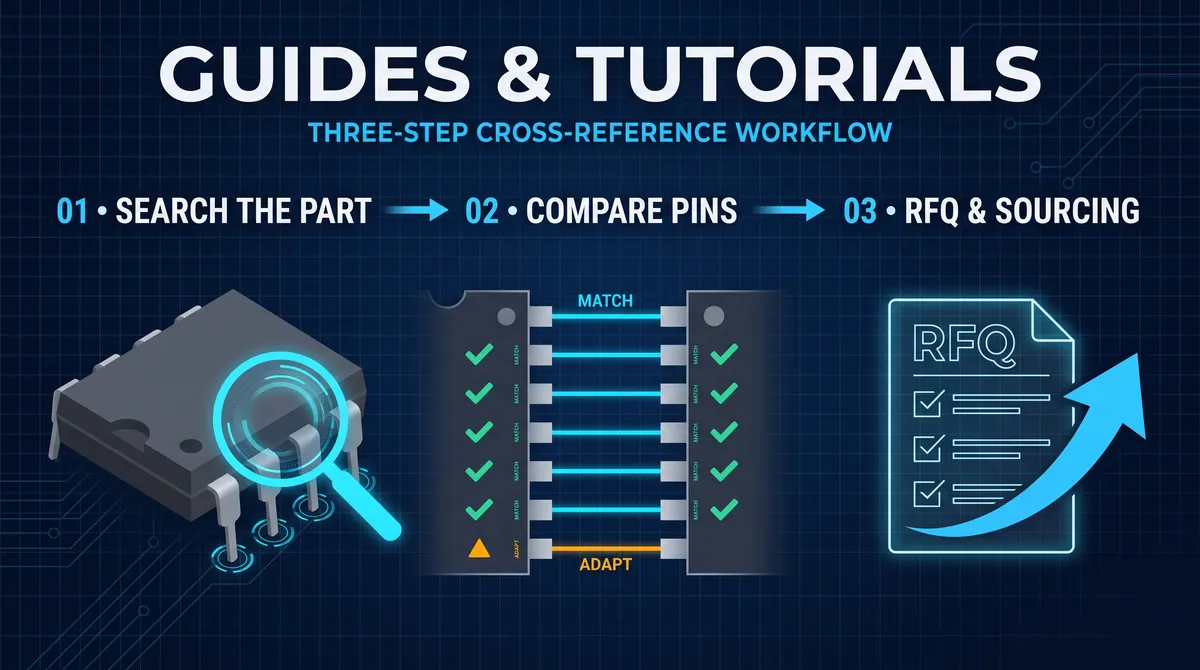
SRAM Replacement Guide: Finding Cross-Compatible Memory ICs for Legacy System Upgrades
Understanding SRAM and the Need for Replacement ICs
SRAM replacement IC cross reference is the systematic process of identifying electrically and mechanically compatible static random-access memory chips to substitute obsolete, failed, or unavailable original components in legacy electronic systems. SRAM, or Static Random Access Memory, represents a type of semiconductor memory that uses bistable latching circuitry to store each bit of data without requiring periodic refresh cycles—a characteristic that distinguishes it fundamentally from dynamic RAM (DRAM). The most common SRAM densities in industrial and automotive applications range from 64 Kbit to 16 Mbit, with access times typically falling between 10 ns and 70 ns depending on the technology generation and speed grade. Unlike DRAM, which stores data as charges in capacitors and requires continuous refreshing, SRAM maintains data as long as power is supplied, making it particularly suitable for applications requiring predictable, low-latency memory access without the complexity of refresh management. SRAM replacement IC cross reference becomes critical when original manufacturers discontinue parts, when supply chain disruptions render specific part numbers unavailable, or when systems require memory upgrades to support enhanced functionality while preserving existing board layouts and firmware architectures.
The landscape of SRAM procurement has shifted dramatically over the past decade, with major manufacturers including Cypress (now Infineon), ISSI, Micron, and Samsung consolidating their product lines or exiting certain memory segments entirely. This consolidation has created significant challenges for industries that depend on long-term component availability—sectors such as industrial automation, medical imaging, telecommunications infrastructure, aerospace electronics, and automotive control systems often require component continuity spanning 15 to 25 years or more. When an SRAM component becomes obsolete or allocation-only, engineers must navigate a complex decision matrix that balances electrical compatibility, mechanical form factor, firmware implications, regulatory compliance, and supply chain risk. The SRAM replacement IC cross reference process addresses each of these dimensions through structured evaluation methodologies that enable confident substitution decisions without compromising system reliability or performance.
Typical applications deploying SRAM in legacy systems include buffer memory for data acquisition front-ends where the deterministic access time of SRAM eliminates latency variability inherent in DRAM refresh cycles, configuration storage in field-programmable gate array (FPGA) development boards where fast reconfiguration times are essential, cache memory in embedded processors requiring single-cycle access for instruction and data streams, network packet buffering in routing equipment where packet loss tolerance approaches zero, and industrial PLC (Programmable Logic Controller) systems where memory integrity directly impacts process safety and operational continuity. Each application category imposes specific constraints on the replacement candidate's electrical characteristics, temperature range, and qualification status, making a generic one-size-fits-all approach to SRAM replacement impractical and potentially risky.
Key certification and selection dimensions for SRAM replacement include AEC-Q100 automotive qualification for safety-critical applications, MIL-PRF-38535 space-grade screening for orbital and aerospace deployments, IEC 60730 functional safety compliance for industrial equipment, and extended temperature range requirements spanning -40°C to +125°C for under-hood automotive or outdoor industrial installations. The SRAM replacement IC cross reference methodology must account for these application-specific requirements while identifying parts that meet or exceed the original component's specifications across all relevant parameters.
The SRAM Cross-Reference Methodology
Effective SRAM replacement IC cross reference begins with comprehensive documentation of the original component's electrical and mechanical specifications, followed by systematic evaluation of candidate substitutes against those specifications using a structured scoring framework. The process initiates with datasheet acquisition and parameter extraction, where engineers compile a complete specification profile including density (bits), organization (words × bits), supply voltage (VCC), power consumption (active/standby current), access time (tAA), package type, pin count and pinout, temperature range, and applicable certifications. This specification profile becomes the baseline against which all candidate replacements are evaluated, ensuring that substitutions address the full spectrum of requirements rather than optimizing for a single parameter while neglecting others.
The second phase of SRAM replacement IC cross reference involves identifying potential substitute manufacturers and part numbers through multiple information channels: authorized distributor parametric search engines such as DigiKey, Mouser, and Arrow; manufacturer cross-reference databases maintained by major distributors and independent engineering portals; direct consultation with manufacturer field applications engineers who can recommend pin-compatible alternatives; and community knowledge bases including engineering forums, industry publications, and legacy system documentation archives. Modern SRAM replacement IC cross reference frequently reveals multiple viable candidates from secondary sources—notably ISSI, Elite Semiconductor Memory Products, Winbond, and GigaDevice—which may offer improved availability or enhanced specifications compared to original-equipment parts. These second-source manufacturers often design their SRAM products for pin compatibility with industry-standard pinouts defined by original SRAM innovators, enabling drop-in replacement in many applications without board modification.
Parameter matching forms the technical heart of the SRAM replacement IC cross reference process, requiring side-by-side comparison of critical specifications between the original and candidate devices. The most critical parameters include density and organization, where the replacement must match the bit capacity and address/data bus configuration exactly; voltage compatibility, where VCC tolerances must overlap sufficiently to ensure reliable operation across the intended supply range; timing parameters, where tAA, tOH, tCO, and related AC characteristics must meet or improve upon original specifications; and package pinout, where pin functions and physical dimensions must enable the replacement to mount in the same footprint without adapter hardware. A comprehensive SRAM replacement IC cross reference checklist should encompass over 30 individual parameters, categorized into absolute maximum ratings, recommended operating conditions, DC electrical characteristics, AC switching characteristics, and physical package specifications.
The third phase involves practical validation through sample procurement and bench testing, where engineers obtain replacement samples and verify functional compatibility through systematic testing protocols. This testing typically progresses through power-on verification, where the replacement powers up correctly within specified voltage and current limits; memory function tests, where comprehensive write/read patterns validate data integrity across the entire address space; timing validation, where oscilloscope measurements confirm that access times and other timing parameters meet specifications under actual operating conditions; and extended burn-in testing, where the replacement operates under elevated temperature conditions for extended periods to identify infant mortality or thermal sensitivity issues. The SRAM replacement IC cross reference process should document all test results and maintain sample units as reference standards for future procurement decisions.
Key Parameters for SRAM Replacement Evaluation
Density and organization matching represents the foundational requirement for any SRAM replacement IC cross reference effort, as mismatches at this level render all other compatibility considerations moot. SRAM density specifications express the total memory capacity in bits, with common sizes including 256 Kbit, 512 Kbit, 1 Mbit, 2 Mbit, 4 Mbit, 8 Mbit, and 16 Mbit. Organization describes how these bits are arranged relative to address and data buses, with common configurations including ×8 (byte-oriented), ×16 (word-oriented), and ×32 organizations, where the multiplier indicates the data bus width. A replacement with different density or organization cannot substitute directly without firmware modifications to accommodate the altered memory map, making exact matching at this parameter level a hard requirement for most legacy system applications. The SRAM replacement IC cross reference must therefore begin by confirming that the candidate replacement matches the original part's density and organization precisely, noting that density is sometimes expressed in bits (Kb/Mb) and sometimes in bytes (KB/MB)—engineers must convert consistently to avoid confusion.
Supply voltage compatibility determines whether the replacement can operate reliably within the original system's power architecture, which may have limited adjustment capability or may be governed by strict regulatory requirements regarding power consumption. Standard SRAM supply voltages have evolved over time, with legacy systems typically operating at 5V (very old designs), 3.3V (common for systems designed in the 1990s through 2000s), and 2.5V or 1.8V (for lower-power designs). Modern SRAM devices often support wide voltage ranges such as 2.0V to 3.6V or 1.8V to 3.6V, enabling operation in systems designed around different nominal voltages. However, the SRAM replacement IC cross reference must verify not just nominal voltage match but also the replacement's voltage tolerance window and current consumption characteristics, as higher-current replacements may stress power distribution networks or violate thermal budgets in enclosed system environments.
| Parameter Category | Original Specification | Replacement Minimum | Replacement Preferred | Notes |
|---|---|---|---|---|
| Density | Match exactly | Match exactly | Match exactly | No substitution without firmware changes |
| Organization | Match exactly | Match exactly | Match exactly | ×8, ×16, ×32 configurations |
| VCC | 3.3V ±10% | System VCC within range | Full system tolerance | Check brown-out conditions |
| tAA (Access Time) | 70 ns max | ≤ Original spec | ≤ 80% of original | Faster acceptable |
| ICC (Active Current) | 30 mA max | ≤ Original spec | ≤ 80% of original | Check power budget |
| ISB (Standby Current) | 5 μA max | ≤ Original spec | ≤ 50% of original | Critical for battery backup |
| Package | 32-TSOP | Match pinout | Same or compatible | Pin-compatible preferred |
| Temperature | -40°C to +85°C | Meet application range | Exceed application range | Automotive requires -40°C to +125°C |
Timing parameters govern how quickly the SRAM can reliably capture address and control inputs and present valid data outputs, with these specifications directly impacting system performance and potentially affecting compatibility with processor bus timing constraints. The address access time (tAA) measures the delay from valid address presentation to valid data output, while chip select access time (tCO) measures the delay from chip enable to data output. Other critical timing parameters include output enable access time (tOHA), which governs tri-state recovery; write pulse width (tWP) and address setup/hold times (tDS, tDH) which define write cycle requirements; and bus turnaround time (tSWR) which becomes relevant in systems with bidirectional data buses. A thorough SRAM replacement IC cross reference must compare all timing specifications across the full operating voltage and temperature ranges specified for the application, as timing margins can vary significantly with these environmental factors.
Pinout Compatibility and Package Considerations
Pinout compatibility determines whether a replacement SRAM can mount directly onto the original circuit board without physical modification, making it a primary filter in the SRAM replacement IC cross reference process. SRAM packages have evolved through several generations, with through-hole packages (DIP, CERDIP) now largely obsolete except in some legacy industrial equipment, while surface-mount packages dominate current production. The most common SRAM packages include TSOP (Thin Small Outline Package) with 32, 44, or 48 pins in various pin pitches; BGA (Ball Grid Array) with 36, 48, or 64 balls offering smaller footprint and better thermal performance; SOIC (Small Outline Integrated Circuit) for lower-density applications; and LCC (Leadless Chip Carrier) for military and aerospace applications requiring ceramic packaging and hermetic sealing.
Pin-compatible SRAM replacements share identical pin functions and positions with the original part, enabling drop-in substitution without solder work or board modification. Industry-standard SRAM pinouts have been defined by JEDEC standards and de facto industry conventions, with organizations such as ×8, ×16, and ×32 configurations each having standardized pin assignments for address, data, control, and power pins. When evaluating pin compatibility in SRAM replacement IC cross reference, engineers must verify not just the number of pins and their functions but also the pin pitch (distance between pin centers), package body dimensions, and pin sequence, as variations in any of these dimensions may prevent physical mounting even when electrical compatibility exists.
The SRAM replacement IC cross reference process must distinguish between true pin-compatible replacements and near-compatible alternatives that require adapter boards or minor modifications. Adapter boards—typically small PCBs that accept the replacement package and present the original pinout—can enable substitution when direct replacements are unavailable, but they introduce additional parasitics (inductance, capacitance), increase board footprint, and may compromise signal integrity at high frequencies. For safety-critical applications, adapter usage requires thorough re-qualification including thermal testing, vibration testing, and long-term reliability assessment. The preference in SRAM replacement IC cross reference should always be for direct pin-compatible substitutes, with adapter-based solutions considered only when no compatible replacement exists and system modification is impractical or prohibited.
Thermal considerations influence package selection in SRAM replacement IC cross reference, as different packages offer different thermal resistance characteristics that affect junction temperature under given power dissipation and ambient conditions. Ceramic packages (CDIP, CLCC, LCC) provide superior thermal conductivity compared to plastic packages (PDIP, SOIC, TSOP) and maintain hermeticity essential for space and high-reliability applications, but they cost significantly more and may face supply constraints. Plastic TSOP packages offer a good balance of cost, thermal performance, and manufacturing maturity for commercial and industrial applications, while BGA packages provide the lowest thermal resistance due to direct die-attach to the package substrate but introduce assembly complexity. The SRAM replacement IC cross reference should evaluate thermal performance through the junction-to-ambient thermal resistance parameter (θJA), comparing replacement and original values to ensure adequate thermal margin in the target application environment.
Sourcing Strategies for Replacement SRAM ICs
Authorized distributor networks represent the most reliable sourcing channel for SRAM replacement IC cross reference candidates, offering traceable supply chains, manufacturer warranty support, and assurance of genuine parts. Major authorized distributors including DigiKey, Mouser Electronics, Arrow Electronics, Avnet, and RS Components maintain extensive inventories of SRAM devices from multiple manufacturers, searchable through parametric databases that enable rapid identification of compatible alternatives. These distributors also offer value-added services such as custom tape-and-reel packaging, programming services for pre-configured devices, and technical support from applications engineers who can assist with SRAM replacement IC cross reference decisions. While authorized distributor pricing typically exceeds independent market pricing, the reliability and traceability benefits justify the premium for applications where failure carries significant consequences.
Independent distribution channels including brokers, independent distributors, and surplus/decommissioned parts suppliers can offer SRAM replacement candidates at substantially lower prices, but they introduce risks that must be carefully managed. Counterfeit components remain a concern in the independent market, with reported rates ranging from 1% to 5% of parts in some market segments, potentially including mismarked, remarked, or fully fraudulent devices. Risk mitigation strategies for independent sourcing include verification of supplier credentials and industry certifications; visual inspection of received parts against reference samples or photographs; electrical testing of random samples from each lot; and maintaining audit trails documenting chain of custody from supplier through delivery. For SRAM replacement IC cross reference applications, independent sourcing may be appropriate for non-critical applications with acceptable failure modes, but safety-critical applications should generally insist on authorized supply chain verification.
Long-term availability planning should inform SRAM replacement IC cross reference decisions, as systems often remain in service for decades after initial deployment. Engineers should evaluate the selected replacement candidate's lifecycle status, checking whether the manufacturer has published end-of-life notifications or obsolescence forecasts; assess the likelihood of future availability based on the manufacturer's market position, financial stability, and product portfolio strategy; consider second-sourcing the replacement by qualifying candidates from multiple manufacturers to reduce singl
| Sourcing Channel | Reliability | Price | Traceability | Best For |
|---|---|---|---|---|
| Authorized Distributor | Highest | Premium | Full | Safety-critical, long-term programs |
| Manufacturer Direct | Highest | Variable | Full | High volume, custom requirements |
| Independent Distributor | Moderate | Competitive | Limited | Non-critical, cost-sensitive |
| Broker | Variable | Variable | Minimal | Emergency one-off needs |
| Lifetime Buy | N/A | Higher upfront | Full (if documented) | Obsolete parts, long service life |
Application-Specific SRAM Replacement Considerations
Automotive applications impose the most stringent requirements on SRAM replacement IC cross reference, driven by functional safety standards, extended temperature operation, and multi-decade reliability expectations. Automotive SRAM applications include engine control unit (ECU) calibration data storage, instrument cluster configuration memory, infotainment system buffering, and safety system temporary data storage—all requiring memory components that maintain data integrity under harsh thermal conditions and electrical stress. AEC-Q100 qualification defines the baseline automotive quality standard, establishing specific test sequences for temperature cycling, humidity exposure, electrostatic discharge, mechanical shock, and vibration. For automotive SRAM replacement IC cross reference, engineers must verify that replacement candidates carry AEC-Q100 qualification at the appropriate grade (Grade 2: -40°C to +105°C or Grade 1: -40°C to +125°C for under-hood applications) and that qualification documentation is available from the manufacturer.
Industrial applications span a wide range of SRAM usage patterns, from high-speed CNC machine tool buffer memory to process controller configuration storage, each with distinct replacement requirements. Factory automation systems often operate in environments with significant electromagnetic interference (EMI), temperature variation, and vibration, requiring SRAM replacements with adequate margins in all relevant specifications. Industrial SRAM replacement IC cross reference should consider IEC 61800 servo drive standards and IEC 61131 programmable controller standards, which may specify memory retention times, access latencies, or other parameters relevant to replacement qualification. Many industrial equipment manufacturers maintain approved component lists (AVL) that restrict substitution to pre-qualified parts, potentially requiring formal re-qualification for SRAM replacement candidates not already on the approved list.
Medical device applications present unique SRAM replacement IC cross reference challenges, as memory components may fall under FDA device regulation when they store parameters affecting device operation or patient safety. Class II and Class III medical devices require documented verification that component changes do not impact device safety or effectiveness, potentially requiring bench testing, design validation, or even clinical evaluation before deployment. Medical SRAM applications include imaging system frame buffers, therapeutic device parameter storage, and diagnostic equipment calibration data memory. Engineers performing SRAM replacement IC cross reference for medical devices must consult with quality and regulatory affairs specialists to determine whether the replacement constitutes a significant change requiring formal revalidation, or whether verification documentation suffices.
Aerospace and defense applications often require SRAM replacement candidates that meet MIL-PRF-38535 for integrated circuits or MIL-STD-883 for screening, with ceramic packaging, hermetic sealing, and radiation-tolerant or radiation-hardened construction. These requirements substantially restrict the available replacement candidate pool, as only a subset of SRAM manufacturers maintain qualified flows for military/aerospace screening. The SRAM replacement IC cross reference for defense applications should engage directly with manufacturer representatives who specialize in military programs, as they can identify screened or QML-certified alternatives and assist with source control drawing (SCD) development. Lead times for military-qualified SRAM can extend to 26 weeks or longer, and minimum order quantities may be substantial, requiring careful procurement planning.
Cross-Reference Database Resources and Tools
Manufacturer parametric search engines provide authoritative SRAM replacement IC cross reference data, enabling engineers to identify alternatives based on comprehensive specification databases maintained directly by component producers. Cypress/Infineon maintains an extensive SRAM portfolio search tool that enables filtering by density, voltage, speed, and package, with cross-reference recommendations to compatible parts within their own portfolio and to second-source alternatives. ISSI provides similar parametric search capabilities through their website and through distribution partner portals, with the added benefit that many ISSI SRAM parts are specifically designed as pin-compatible replacements for Cypress and Micron products. DigiKey and Mouser maintain comprehensive parametric databases that aggregate SRAM offerings across multiple manufacturers, enabling side-by-side comparison of specifications and availability in a single interface.
Independent cross-reference databases aggregate SRAM replacement IC cross reference information across multiple sources, offering broader coverage but requiring validation against authoritative datasheets. Silicon Experts provides component lifecycle intelligence including obsolescence notifications, alternative recommendations, and cross-references based on extensive industry data aggregation. Octopart offers component search with pricing, availability, and datasheet access across hundreds of distributors, with cross-reference capabilities that identify equivalent parts based on specification matching. These independent tools can rapidly narrow candidate lists for further evaluation, but engineers should always verify cross-reference recommendations against official manufacturer datasheets before committing to substitution.
Engineering community resources including forums, technical blogs, and industry publications often contain valuable SRAM replacement IC cross reference knowledge accumulated from real-world substitution projects. EEEweb, EEVblog community forums, and Hackaday feature discussions where engineers share experiences with specific SRAM replacement challenges, including successful substitutions, pitfalls encountered, and lessons learned. While community-sourced information requires careful validation, it can provide insights into practical compatibility considerations not always documented in official specifications—such as subtle timing margin differences, firmware adjustment requirements, or manufacturing variability that affects substitution success.
| Resource Type | Coverage | Reliability | Access Method |
|---|---|---|---|
| Manufacturer Parametric Search | Single manufacturer | Highest | Manufacturer website |
| Authorized Distributor Search | Multiple manufacturers | High | Distributor website |
| Independent Cross-Reference Service | Broad industry coverage | Moderate-High | Subscription service |
| Engineering Community Forums | Variable | Variable | Free web access |
| Component Datasheet Archives | Comprehensive | High | Distributor/document sites |
Testing and Validation Protocols
Incoming inspection testing forms the first line of defense against SRAM replacement IC cross reference errors, verifying that received replacement units meet specifications before they enter production or system assembly. Incoming inspection should include visual inspection comparing the received part against reference photographs or known-good samples, verifying that markings, package style, and physical dimensions match expectations; electrical testing of random samples using automated test equipment (ATE) capable of exercising all memory functions across the specified voltage and temperature ranges; and documentation of test results including lot codes, date codes, and test equipment calibration status. For high-reliability applications, incoming inspection may include burn-in testing where samples are operated at elevated temperature for 48 to 168 hours before acceptance, identifying infant mortality failures that would otherwise appear during system integration or field operation.
Functional verification testing validates that the SRAM replacement performs correctly in the target system environment, not just in abstract bench testing. This testing should include basic memory function verification, where the system writes and reads back patterns across the entire memory array, confirming data integrity at all addresses; stress testing, where memory is exercised at maximum access rates to identify thermal or timing margin issues; retention testing, where data is written and held for specified durations (potentially days) to verify retention specifications, especially important for battery-backed applications; and system integration testing, where the memory replacement operates in the complete system context, verifying that all system functions requiring memory access operate correctly. The SRAM replacement IC cross reference validation should document all test protocols, pass/fail criteria, and results in a manner suitable for quality record retention requirements.
Long-term reliability monitoring tracks replacement SRAM performance over extended operational periods, identifying failure modes that may not manifest in accelerated testing. Reliability monitoring programs typically include periodic sampling of field returns for failure analysis, tracking of failure rates by lot code to identify potentially problematic production batches, and correlation of failure modes with operating conditions to identify application-specific stress factors. For SRAM replacement IC cross reference in long-lifecycle systems, this monitoring provides early warning of emerging reliability concerns, enabling proactive mitigation before failure rates impact system availability. Statistical process control techniques can identify subtle shifts in replacement quality that might indicate manufacturing changes or incoming counterfeit risks.
Case Studies in SRAM Replacement
Legacy telecommunications switching equipment represents a common SRAM replacement IC cross reference scenario, where systems deployed in the 1990s and 2000s may have accumulated millions of operating hours but face component obsolescence as original manufacturers exit market segments. A representative case involved a TDM (Time Division Multiplexing) switching system using a 512 Kbit ×8 SRAM organized as 4 Mbit total memory, with 70 ns access time in a 32-pin TSOP package operating at 3.3V. The original Cypress part had been discontinued, and the telecom equipment manufacturer needed a compatible replacement to support ongoing maintenance contracts and extend system service life. The SRAM replacement IC cross reference identified three compatible alternatives: an ISSI part with identical specifications and pinout, a Winbond part with improved access time (55 ns vs 70 ns), and a GigaDevice part with extended temperature range (-40°C to +125°C vs -40°C to +85°C). The selection process evaluated not just electrical compatibility but also long-term supply availability projections, ultimately selecting the ISSI part based on manufacturer commitment to 10-year continued availability.
Industrial programmable logic controller (PLC) applications provide another instructive SRAM replacement IC cross reference case, where memory components store configuration parameters, program code, and operational data critical to process control. A packaging machinery OEM encountered repeated failures of a 256 Kbit SRAM used for recipe storage in a plastic injection molding controller, where the original Micron part had become allocation-only with no firm availability commitment. The SRAM replacement IC cross reference process identified that the 256 Kbit density was available in limited options from secondary manufacturers, but higher-density alternatives (512 Kbit, 1 Mbit) offered improved availability with potential for firmware enhancement to utilize additional memory for expanded recipe storage. The evaluation compared partial-memory mapping approaches (using only the lower portion of higher-density parts) against exact-density replacements, ultimately recommending an ISSI 512 Kbit ×8 part with modified firmware that mapped the upper memory address range to unused address space, preserving original functionality while enabling future recipe expansion.
Automotive instrument cluster replacement illustrates the complexity of SRAM replacement IC cross reference in safety-critical applications requiring AEC-Q100 qualification. An automotive tier-1 supplier faced end-of-life notification for a SRAM used in an instrument cluster to store gauge calibration data and warning message content. The cluster design had been validated over multiple years and model iterations, making any electronic change subject to formal re-validation. The SRAM replacement IC cross reference identified multiple pin-compatible alternatives from qualified automotive semiconductor suppliers, but each required re-qualification including thermal testing across the full temperature range (-40°C to +85°C operating, -40°C to +95°C storage), vibration testing per ISO 16750-3, and electrical testing including jump start, reverse polarity, and load dump conditions. The qualification program extended over six months and required engineering resources from both the tier-1 supplier and the automotive OEM, demonstrating that SRAM replacement IC cross reference in automotive applications involves far more than specification matching.
Common Pitfalls and How to Avoid Them
Insufficient parametric verification represents the most frequent SRAM replacement IC cross reference error, where engineers focus on obvious parameters like density and voltage while overlooking critical timing or electrical specifications. A common scenario involves substituting a SRAM with faster access time (improved specification) but different output drive strength or input loading characteristics, which may cause signal integrity issues or timing violations in systems with tight margins. The mitigation strategy requires a comprehensive specification comparison checklist covering all datasheet parameters, with particular attention to input leakage current, output leakage current, and input capacitance values that affect bus loading calculations.
Package marking interpretation errors can lead to accepting incompatible parts that appear superficially similar to the original. SRAM packages with similar pin counts (such as 32-pin and 34-pin TSOP) may appear nearly identical but have different pinouts or pin pitches that prevent correct mounting. Similarly, factory-remarked parts may carry counterfeit markings suggesting the intended replacement while containing different actual dies. The SRAM replacement IC cross reference process should verify package markings against authoritative datasheet specifications, cross-reference lot codes with manufacturer traceability databases where available, and perform incoming electrical testing regardless of markings or appearance.
Firmware assumption errors occur when engineers assume that memory replacement will be transparent to system firmware, without considering how firmware may depend on specific memory timing characteristics or may access memory regions that function differently in the replacement. Some firmware implementations perform timing-critical operations that depend on specific memory access latencies; faster replacement parts may actually cause problems if firmware timing loops assume specific delays. Other firmware implementations may include workarounds for known errata in the original memory part, which could be counterproductive with a corrected replacement. Thorough SRAM replacement IC cross reference requires review of firmware memory access patterns and any documented errata or quirks associated with the original part.
Future Trends in SRAM Replacement and Memory Technology
Emerging non-volatile memory technologies are gradually displacing SRAM in some applications, but legacy systems will continue requiring SRAM replacement IC cross reference capabilities for decades to come. Technologies such as MRAM (Magnetoresistive Random Access Memory), FRAM (Ferroelectric RAM), and nvSRAM (non-volatile SRAM) offer data retention without power supply, potentially eliminating the need for battery backup in some applications. However, these technologies typically cannot match SRAM access times for pure read/write performance, limiting their applicability in high-speed buffer applications. The SRAM replacement IC cross reference process should consider whether emerging memory technologies might offer a superior long-term solution for legacy systems, potentially enabling both replacement and upgrade in a single modification.
Advanced packaging technologies including 3D stacking and embedded memory are changing SRAM procurement patterns, with some newer systems integrating SRAM directly with logic devices rather than using discrete packages. This integration trend may reduce the discrete SRAM replacement market while increasing the complexity of replacement for systems that do use discrete memory. Engineers performing SRAM replacement IC cross reference should monitor packaging technology trends to anticipate how future system designs may affect replacement availability and approach.
Supply chain regionalization trends are reshaping SRAM sourcing strategies, with geopolitical factors increasingly influencing component availability and pricing. The SRAM replacement IC cross reference process should consider not just specification compatibility but also supply chain risk, potentially favoring replacement candidates with diversified manufacturing locations or alternative sources. For systems with long service life expectations, engineers should evaluate the geopolitical stability of regions where replacement candidates are manufactured and the potential impact of trade restrictions or tariffs on future procurement.
Conclusion
SRAM replacement IC cross reference represents a critical competency for organizations supporting legacy electronic systems across industrial, automotive, medical, aerospace, and telecommunications sectors. The process extends far beyond simple specification matching, requiring comprehensive evaluation of electrical, mechanical, thermal, and regulatory compatibility factors alongside practical considerations of supply chain sustainability and long-term availability. Effective SRAM replacement IC cross reference programs establish structured methodologies, maintain documentation repositories, and build relationships with specialized distributors and manufacturers who can support legacy component needs.
The key to successful SRAM replacement lies in systematic methodology: beginning with complete specification documentation of the original component; applying multi-parameter compatibility evaluation across all relevant electrical and physical characteristics; engaging authoritative information sources including manufacturer parametric databases and approved distributor cross-reference tools; validating replacement candidates through comprehensive testing protocols; and establishing ongoing monitoring to detect emerging reliability or availability concerns. Organizations that invest in robust SRAM replacement IC cross reference capabilities can extend system service life significantly, protecting embedded capital in legacy equipment while meeting obligations to customers who depend on system availability.
As the semiconductor industry continues consolidation and technology evolution accelerates the pace of component obsolescence, the importance of SRAM replacement IC cross reference expertise will only increase. Engineers who master these methodologies position themselves to deliver exceptional value by enabling their organizations to maintain critical systems economically and reliably over extended operational lifecycles.
Not sure which sensor fits your project?
Talk to our mmWave application engineers for a free consultation.
Specify your hotel project with our engineers
Send your room count, ceiling type, and protocol preference. We will return a sample plan and quote within 24 business hours.
- Move from general guidance into a product or application discussion.
- Use RFQ when pricing, drawings, MOQ, or launch timing needs structure.
- Keep a direct contact path visible for fast clarifications and handoff.